Book Store runs three versions of reviews side by side, and the reviews Service spreads
requests across all of them. Chapter 1 measured it: about a third each, with no way to change
the split except by changing the number of Pods. That’s not how a team wants to release. The
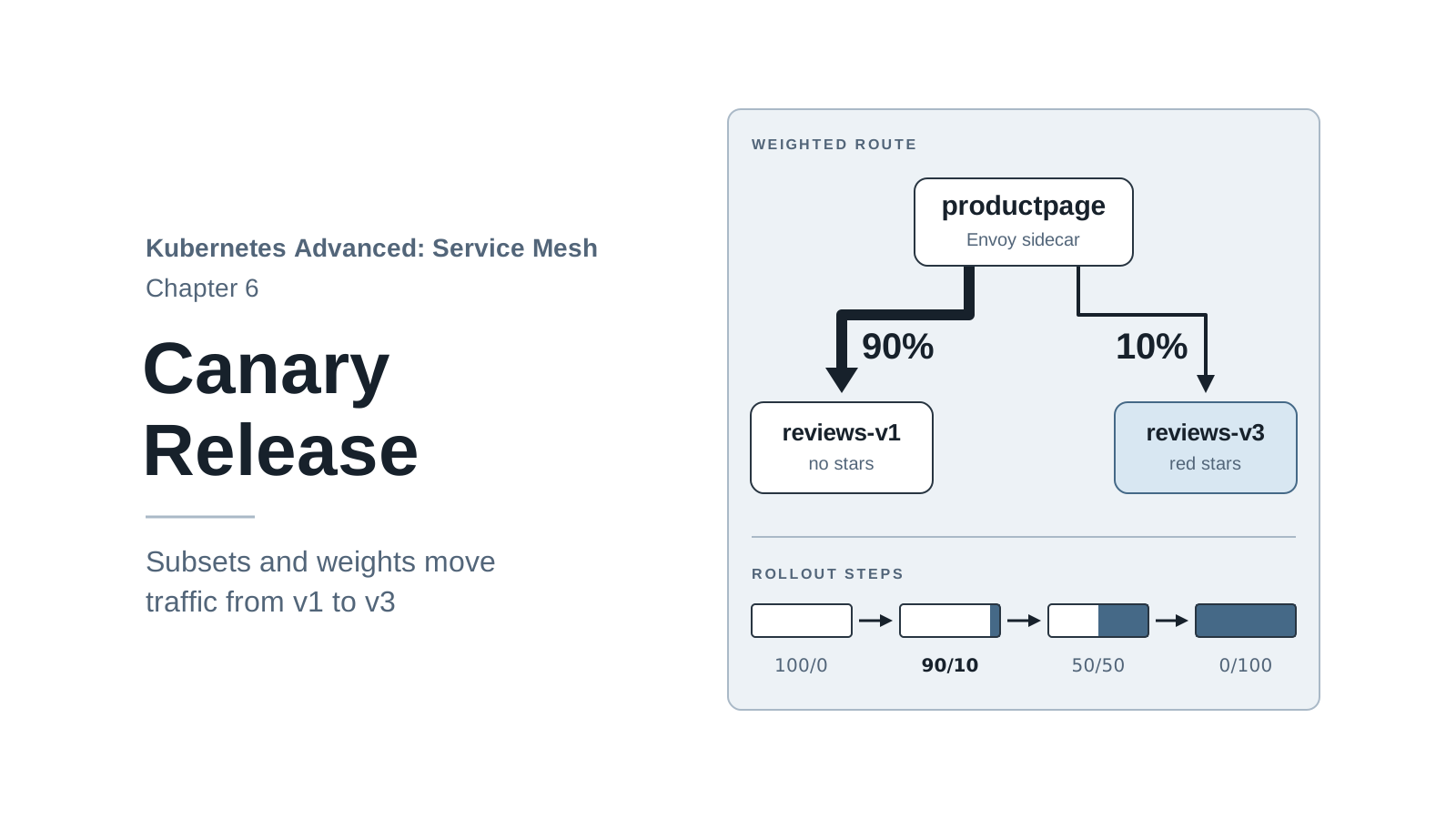
reviews team has finished v3, which shows red stars, and wants it to reach users gradually:
first a small share, then half, then everyone, with a one-command rollback at every step.
That gradual move is the canary release from chapter 1. In Istio it takes two objects. A
DestinationRule gives each version a name. A VirtualService says how much traffic each name
gets. This chapter introduces both and runs the canary from 0% to 100%. It also shows where the
routing decision happens: in the sidecar of the service that makes the call, not at the reviews
Service. That detail decides which clients your canary actually covers.
By the end of this chapter you will:
- Define subsets of a service by Pod label with a
DestinationRule. - Route traffic inside the mesh with a
VirtualServicethat has no gateway. - Shift traffic between versions by weight and measure each step.
- Explain why a client without a sidecar ignores all of this.
- Apply
DestinationRuleandVirtualServicein the right order, and recognize the503you get when the order is wrong.
Code for this chapter. The files are in _resource/kubernetes-service-mesh/06-traffic-shifting. I tested them with Kind v0.33.0 (Kubernetes v1.37.0) and Istio 1.32.0 on macOS with Docker Desktop, and the command output in this chapter comes from those runs.
Starting Point
Run every command from _resource/kubernetes-service-mesh with the series’ istioctl on your
PATH (export PATH="$PWD/bin:$PATH"). The chapter needs Book Store in the mesh and reachable at
http://bookstore.local:8080, the state chapter 5 ended in. To build it from scratch:
./scripts/bootstrap.sh 06
Measure the current split with the script from chapter 1. It calls the reviews API through the gateway and counts which version answered:
./scripts/count-versions.sh http://bookstore.local:8080 30
  14 200 reviews-v2 stars fast
   9 200 reviews-v1 no-stars fast
   7 200 reviews-v3 stars fast
Roughly a third each. The plan is to send everything to v1 first, then move traffic to v3 in steps.
Two Objects: Where to Send, and What the Names Mean
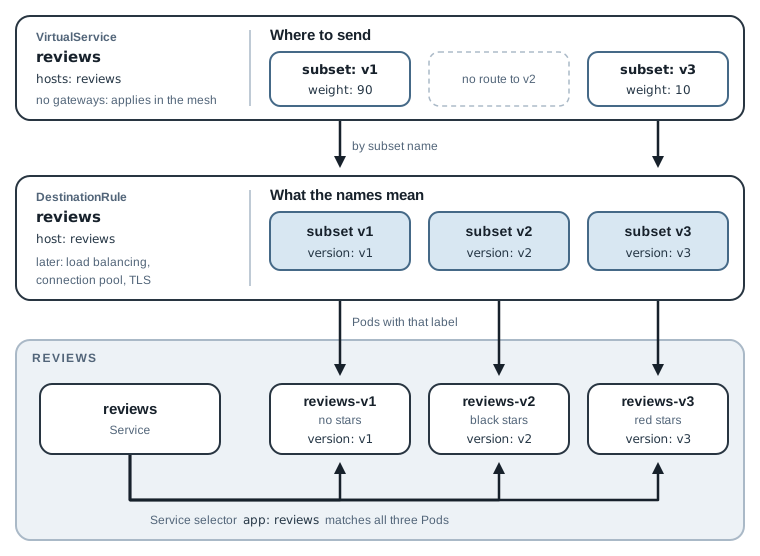
Routing between versions needs two pieces of information, and Istio keeps them in two objects:
- A
VirtualServicedecides where a request goes: which subset, with which weight, for which request. You met it at the gateway in chapter 3. - A
DestinationRuledefines what a destination is and how to treat it once chosen: its subsets in this chapter, and later traffic policies such as connection limits (chapter 9) and TLS settings (chapter 11).
A subset is a named group of a Service’s Pods, selected by label. reviews already has the
label it needs: every Deployment from chapter 1 sets version: v1, v2, or v3 on its Pods,
while the Service selects only by app: reviews.
06-traffic-shifting/destinationrule-reviews.yaml:
apiVersion: networking.istio.io/v1
kind: DestinationRule
metadata:
  name: reviews
  namespace: bookstore
spec:
  host: reviews
  subsets:
    - name: v1
      labels:
        version: v1
    - name: v2
      labels:
        version: v2
    - name: v3
      labels:
        version: v3
host: reviews is the Kubernetes Service, completed with the object’s namespace
(reviews.bookstore.svc.cluster.local). Each subset is a name plus a label selector applied to
that Service’s Pods. The names are yours to choose; using the version label’s values keeps them
obvious.
Break It First: The Wrong Apply Order
The canary’s first step pins all traffic to v1. That’s a VirtualService that sends reviews
traffic to subset v1, 06-traffic-shifting/virtualservice-reviews-v1.yaml:
apiVersion: networking.istio.io/v1
kind: VirtualService
metadata:
  name: reviews
  namespace: bookstore
spec:
  hosts:
    - reviews
  http:
    - route:
        - destination:
            host: reviews
            subset: v1
This VirtualService has no gateways field. Without it, the routes apply inside the mesh:
to every sidecar that sends a request to reviews (Istio calls this the implicit mesh
gateway). productpage calls http://reviews:9080, so its sidecar uses these routes.
A common mistake is to apply the VirtualService before the DestinationRule it depends on.
Make that mistake on purpose:
kubectl apply -f 06-traffic-shifting/virtualservice-reviews-v1.yaml
./scripts/count-versions.sh http://bookstore.local:8080 10
virtualservice.networking.istio.io/reviews created
  10 503 reviews-none - fast
Every request fails. productpage returns 503 with
{"error": "Sorry, product reviews are currently unavailable for this book."}, because its call
to reviews failed. The call to reviews leaves through productpage’s sidecar, so that
sidecar’s access log has the response flag (chapter 5’s table):
kubectl -n bookstore logs deploy/productpage-v1 -c istio-proxy --tail=20 | grep 'reviews:9080' | tail -1
[2026-11-17T01:31:22.161Z] "GET /reviews/0 HTTP/1.1" 503 NC cluster_not_found - "-" 0 0 0 - "-" "curl/8.7.1" "67a74735-9be2-4dad-83d4-9500afff57c0" "reviews:9080" "-" - - 10.96.121.127:9080 10.244.2.16:33972 - -
The flag is NC cluster_not_found, and the upstream host and cluster are both -: nothing was
called. In chapter 5, NC came from a wrong destination.host. Here the host is right, but the
route points at a cluster for subset v1, and that cluster doesn’t exist because nothing has
defined v1 yet. istioctl analyze names the missing piece:
istioctl analyze -n bookstore
Error [IST0101] (VirtualService bookstore/reviews) Referenced host+subset in destinationrule not found: "reviews+v1"
Error: Analyzers found issues when analyzing namespace: bookstore.
See https://istio.io/v1.32/docs/reference/config/analysis for more information about causes and resolutions.
Apply the DestinationRule:
kubectl apply -f 06-traffic-shifting/destinationrule-reviews.yaml
./scripts/count-versions.sh http://bookstore.local:8080 20
destinationrule.networking.istio.io/reviews created
  20 200 reviews-v1 no-stars fast
All 20 requests went to v1, with no restart and no change to any Deployment. Look at the
clusters productpage’s sidecar has for reviews now:
istioctl proxy-config cluster deploy/productpage-v1 -n bookstore --fqdn reviews.bookstore.svc.cluster.local
SERVICE FQDN                            PORT     SUBSET     DIRECTION     TYPE     DESTINATION RULE
reviews.bookstore.svc.cluster.local     9080     -          outbound      EDS      reviews.bookstore
reviews.bookstore.svc.cluster.local     9080     v1         outbound      EDS      reviews.bookstore
reviews.bookstore.svc.cluster.local     9080     v2         outbound      EDS      reviews.bookstore
reviews.bookstore.svc.cluster.local     9080     v3         outbound      EDS      reviews.bookstore
One cluster per subset, plus the original one for the whole Service. The subset clusters are
named outbound|9080|v1|reviews...: the third field, empty in chapter 5, now holds the subset.
The rule for your own releases: add the DestinationRule first, then the VirtualService
that uses it. When removing, delete the VirtualService first. Putting both in one
kubectl apply usually works, but nothing guarantees that every sidecar receives the subsets
before the route that needs them, so a busy service can see a few 503s in between. The safe
sequence is two steps: apply the DestinationRule, wait a few seconds until
istioctl proxy-config cluster shows the subset clusters, then apply the VirtualService.
Run the Canary
With v1 pinned, release v3 in steps. Each step is one file with the same VirtualService
name, so applying it replaces the previous routes. Only the weights change.
06-traffic-shifting/virtualservice-reviews-90-10.yaml:
# ... apiVersion, kind, and metadata as in virtualservice-reviews-v1.yaml
spec:
  hosts:
    - reviews
  http:
    - route:
        - destination:
            host: reviews
            subset: v1
          weight: 90
        - destination:
            host: reviews
            subset: v3
          weight: 10
Each weight is a share of the rule’s traffic. Istio treats the weights as relative (each
destination gets its weight divided by the total), but keeping the total at 100 lets you read
them as percentages. (I checked: weights of 9 and 1 passed istioctl analyze and split 100
requests 92/8.) The sidecar picks a destination at random for every request with these odds,
so small samples drift; 100 requests give a fair picture.
kubectl apply -f 06-traffic-shifting/virtualservice-reviews-90-10.yaml
./scripts/count-versions.sh http://bookstore.local:8080 100
virtualservice.networking.istio.io/reviews configured
  89 200 reviews-v1 no-stars fast
  11 200 reviews-v3 stars fast
89 and 11, close to 90/10. This is the step where a real team watches v3’s error rate and latency (chapter 13 shows how) before going further. Next, half and half:
kubectl apply -f 06-traffic-shifting/virtualservice-reviews-50-50.yaml
./scripts/count-versions.sh http://bookstore.local:8080 100
virtualservice.networking.istio.io/reviews configured
  56 200 reviews-v1 no-stars fast
  44 200 reviews-v3 stars fast
And finally all traffic to v3:
kubectl apply -f 06-traffic-shifting/virtualservice-reviews-v3.yaml
./scripts/count-versions.sh http://bookstore.local:8080 100
virtualservice.networking.istio.io/reviews configured
 100 200 reviews-v3 stars fast
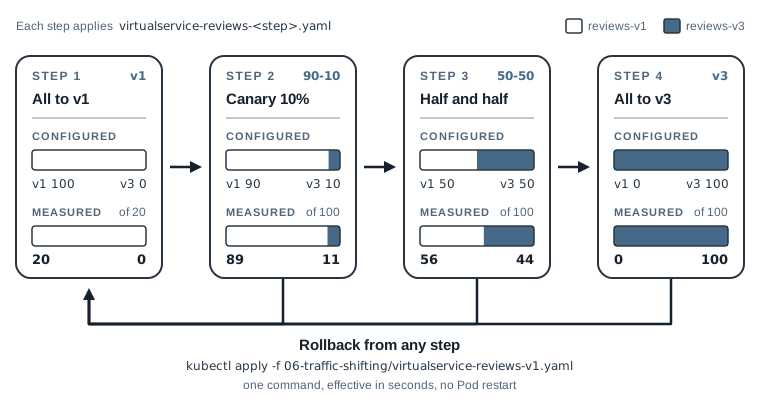
v1 still runs, receiving nothing. Rolling back at any step is one command,
kubectl apply -f 06-traffic-shifting/virtualservice-reviews-v1.yaml, and takes effect in
seconds because no Pod starts or stops. When v3 has run on full traffic long enough to trust it,
the team deletes the v1 Deployment.
Notice what didn’t happen. Unlike chapter 1, where the split depended on Pod counts and on which connections happened to be open, every split here came from a number in YAML, and v3 ran on one Pod the whole time. Traffic share and capacity are now separate decisions. That cuts both ways: the mesh won’t add v3 Pods when you raise its weight, so scale v3 for full traffic before the last step.
The random pick per request has one more consequence. The same user can get v1 on one page load and v3 on the next. For a change in star color that’s harmless. For a new checkout flow or a changed API response, it may not be, and a percentage can’t fix that. Chapter 7 sends chosen users to one version instead.
Where the Decision Is Made
Ask where “send 10% to v3” happens. The intuitive answer is “at the reviews Service”, and it’s
wrong. A Kubernetes Service is only an IP and a set of packet rules; it knows nothing about
subsets. The decision is made in the caller’s sidecar. Put the 90/10 split back:
kubectl apply -f 06-traffic-shifting/virtualservice-reviews-90-10.yaml
Then look at the route in productpage’s sidecar. The full JSON is long, so the Python snippet
prints only the weights of the reviews route. (Without python3, stop the command at -o json
and search the output for weightedClusters.)
istioctl proxy-config route deploy/productpage-v1 -n bookstore --name 9080 -o json | python3 -c '
import json, sys
for rc in json.load(sys.stdin):
    for vh in rc["virtualHosts"]:
        if vh["name"].startswith("reviews."):
            print(json.dumps(vh["routes"][0]["route"]["weightedClusters"], indent=2))'
{
  "clusters": [
    {
      "name": "outbound|9080|v1|reviews.bookstore.svc.cluster.local",
      "weight": 90
    },
    {
      "name": "outbound|9080|v3|reviews.bookstore.svc.cluster.local",
      "weight": 10
    }
  ]
}
--name 9080 selects the route table for outbound calls to port 9080. Its reviews virtual host
holds the weights. When the productpage app calls reviews:9080, its sidecar rolls the 90/10
dice and sends the request straight to a Pod in the chosen subset. The reviews Pods receive the
request already decided.
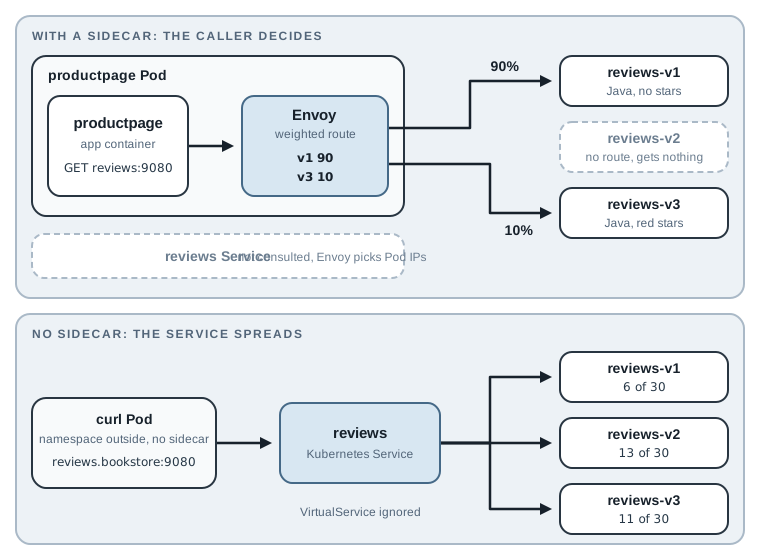
It follows that a client without a sidecar never sees the VirtualService. To check, leave the
90/10 route in place, start a test Pod in a namespace without sidecar injection, and call
reviews 30 times directly. The grep pair pulls the version out of each JSON answer:
kubectl create namespace outside
kubectl -n outside run curl --image=docker.io/curlimages/curl:8.16.0 \
  --restart=Never --command -- sleep 3600
kubectl -n outside wait --for=condition=Ready pod/curl --timeout=90s
kubectl -n outside exec curl -- sh -c 'for i in $(seq 30); do
  curl -s http://reviews.bookstore:9080/reviews/0 | grep -o "\"podname\": *\"reviews-v[0-9]" | grep -o "v[0-9]$"
done | sort | uniq -c'
namespace/outside created
pod/curl created
pod/curl condition met
      6 v1
     13 v2
     11 v3
All three versions, including v2, which no route mentions. The request went through the plain
Kubernetes Service, exactly as in chapter 1. This matters in practice. A Pod in a namespace
without injection, a Job that runs with injection turned off, or a client that reaches reviews
through a NodePort instead of through productpage all bypass your canary. A mesh-internal
VirtualService like this one only governs calls that leave a sidecar. (A gateway applies only
the VirtualService objects that name it in gateways, as in chapter 3.) Chapter 11 shows how
to block clients without a sidecar altogether.
Tip: Kiali shows the same split. Send traffic through the gateway first (
./scripts/count-versions.sh http://bookstore.local:8080 100), because the graph only draws recent requests. Then open it withistioctl dashboard kiali, choose the “Versioned app graph” forbookstore, and enable the “Traffic Distribution” edge label: the edges fromproductpagetoreviewsv1 and v3 show their percentages.
Reset Before the Next Chapter
Delete the VirtualService and the test namespace. Keep the DestinationRule: chapter 7 routes
to the same subsets. (If you remove the DestinationRule in your own cluster, delete the
VirtualService first, as the rule above says.)
kubectl delete -f 06-traffic-shifting/virtualservice-reviews-90-10.yaml
kubectl delete namespace outside
./scripts/count-versions.sh http://bookstore.local:8080 30
virtualservice.networking.istio.io "reviews" deleted
namespace "outside" deleted
  11 200 reviews-v3 stars fast
  10 200 reviews-v2 stars fast
   9 200 reviews-v1 no-stars fast
Without a VirtualService, the sidecars balance across all of the Service’s Pods again. To
rebuild the starting state of chapter 7 from scratch: ./scripts/bootstrap.sh 07.
Summary
- A
DestinationRuledefines subsets: named groups of a Service’s Pods selected by label. AVirtualServicesends traffic to those names with weights. - A
VirtualServicewithoutgatewaysapplies inside the mesh, to every sidecar that calls the host. - Apply the
DestinationRulebefore theVirtualService. A route to an undefined subset fails with503 NC cluster_not_found, andistioctl analyzereportsIST0101. - A canary is a series of weight changes: 90/10, 50/50, and 0/100, measured as 89/11, 56/44,
and 0/100. Rollback is one
kubectl applyand needs no Pod restart. - The decision is made in the caller’s sidecar. A client without a sidecar ignores the
VirtualService. Next, chapter 7 routes by who the user is instead of by percentage.