Every chapter so far has dealt with traffic that enters the mesh or moves inside it. Most apps also call out: a payment provider, a partner API, a cloud storage bucket. By default, Istio lets a Pod call any address on the internet, and the sidecar has no rules for those calls: no route, no retry, and often nothing in the log but an IP address and a byte count. For a security team, that’s two problems. Nobody can say which services talk to which outside hosts, and a compromised Pod can send data anywhere.
The Book Store team now has a partner: a book catalog service run by another company. The
security team’s requirements are simple to state. Only approved external hosts may be called.
Every call to the partner must leave through one place that logs it, so there’s one audit trail
and, later, one place to put firewall rules. Istio has an object for each part: an outbound
traffic policy that blocks unknown hosts, a ServiceEntry that approves a host, and an egress
gateway that serves as the exit point.
By the end of this chapter you will:
- See how a sidecar handles a call to a host it doesn’t know (
PassthroughCluster), and block such calls withREGISTRY_ONLY(BlackHoleCluster). - Register an external host with a
ServiceEntryand get full HTTP visibility for its calls. - Route calls to that host through the egress gateway with a two-hop
VirtualService. - Encrypt and authenticate the hop to the egress gateway with
ISTIO_MUTUAL. - Diagnose a
ServiceEntrywith the wrong protocol from the sidecar’s listener.
Code for this chapter. The files are in _resource/kubernetes-service-mesh/10-egress. I tested them with Kind v0.33.0 (Kubernetes v1.37.0) and Istio 1.32.0 on macOS with Docker Desktop, and the command output in this chapter comes from those runs.
Starting Point
Run every command from _resource/kubernetes-service-mesh:
export PATH="$PWD/bin:$PATH"
The chapter needs Istio installed (with the egress gateway that chapter 2’s install file turns on) and Book Store in the mesh. Any state from chapter 3 on works. To build it from scratch:
./scripts/bootstrap.sh 10
Check that the egress gateway is running:
kubectl -n istio-system get deploy istio-egressgateway
The READY column should show 1/1. If the Deployment doesn’t exist, Istio was installed
without the egress gateway; rebuild with the bootstrap.sh command above.
An “External” Service on Your Machine
A real partner API would need internet access, an account, and a rate limit that a tutorial can’t control. Instead, the partner catalog runs as a Docker container outside the Kind cluster, on the same Docker network as the Kind nodes. To the mesh it is exactly like an outside host: no sidecar, not a Kubernetes Service, reachable only by name over the network.
docker run -d --name partner-catalog --network kind \
  --network-alias catalog.partner.example \
  --restart unless-stopped docker.io/mccutchen/go-httpbin:v2.15.0
The container runs go-httpbin, the same image Istio’s httpbin sample uses. It listens on port
8080 and echoes requests back. --network kind puts it on the Kind nodes’ Docker network, and
--network-alias gives it the DNS name catalog.partner.example there. Pods can resolve that
name because Kubernetes DNS forwards unknown names to the node, and the node asks Docker. (The
.example domain is reserved for documentation, so it can never clash with a real site.)
--restart unless-stopped brings the container back if Docker restarts in the middle of the
chapter.
The caller is a small client Pod in bookstore, defined in 10-egress/tester.yaml. It only
runs sleep, so you can run curl in it with kubectl exec, and it gets a sidecar like every
Pod in the namespace. Deploy it and call the partner:
kubectl apply -f 10-egress/tester.yaml
kubectl -n bookstore rollout status deploy/tester
kubectl -n bookstore exec deploy/tester -c tester -- \
  curl -s -o /dev/null -w "%{http_code}\n" http://catalog.partner.example:8080/get
serviceaccount/tester created
deployment.apps/tester created
Waiting for deployment "tester" rollout to finish: 0 of 1 updated replicas are available...
deployment "tester" successfully rolled out
200
The call works. Now look at what the sidecar recorded:
kubectl -n bookstore logs deploy/tester -c istio-proxy --tail=1
[2026-11-17T01:55:40.000Z] "- - -" 0 - - - "-" 95 475 2 - "-" "-" "-" "-" "172.21.0.5:8080" PassthroughCluster 10.244.2.25:49472 172.21.0.5:8080 10.244.2.25:49464 - -
No method, no path, no status: "- - -" is a TCP connection, 95 bytes out and 475 back, to the
IP 172.21.0.5. The cluster is PassthroughCluster, the catch-all that Istio gives every
sidecar for destinations it knows nothing about (chapter 2 showed it on the outbound capture
port, 15001). It forwards the bytes and understands none of them. This is Istio’s default
outbound policy, ALLOW_ANY: any destination is allowed, and the sidecar sees only an IP and a
byte count.
Block Unknown Hosts: REGISTRY_ONLY
The opposite policy is REGISTRY_ONLY: a sidecar only sends traffic to hosts in Istio’s service
registry, the list of everything istiod knows about. Kubernetes Services are in it
automatically. External hosts are not.
You can set the policy for the whole mesh in the install file
(meshConfig.outboundTrafficPolicy.mode), which means running istioctl install again. A
Sidecar object sets it for one namespace with a plain kubectl apply, which is easier to try
and to undo. 10-egress/sidecar-registry-only.yaml:
apiVersion: networking.istio.io/v1
kind: Sidecar
metadata:
  name: default
  namespace: bookstore
spec:
  outboundTrafficPolicy:
    mode: REGISTRY_ONLY
A Sidecar object tunes the configuration of the sidecars in its namespace. One without a
workloadSelector applies to every Pod in the namespace. A namespace should have only one of
those, and by convention it’s named default. Apply it and call the partner again:
kubectl apply -f 10-egress/sidecar-registry-only.yaml
kubectl -n bookstore exec deploy/tester -c tester -- \
  curl -sS -o /dev/null -w "%{http_code}\n" http://catalog.partner.example:8080/get
kubectl -n bookstore logs deploy/tester -c istio-proxy --tail=1
sidecar.networking.istio.io/default created
000
curl: (56) Recv failure: Connection reset by peer
command terminated with exit code 56
[2026-11-17T01:56:22.564Z] "- - -" 0 UH - - "-" 0 0 0 - "-" "-" "-" "-" "-" BlackHoleCluster - 172.21.0.5:8080 10.244.2.25:34726 - -
Blocked. The sidecar sent the connection to BlackHoleCluster, a cluster with no endpoints, so
Envoy logged UH (no healthy upstream, the flag from chapter 5’s table) and closed the
connection. The app sees a reset connection, curl’s exit code 56. Book Store itself keeps
working, because every service it calls is a Kubernetes Service:
./scripts/count-versions.sh http://bookstore.local:8080 10
   4 200 reviews-v1 no-stars fast
   3 200 reviews-v3 stars fast
   3 200 reviews-v2 stars fast
All ten requests return 200. The policy blocks only hosts that Istio doesn’t know.
Approve a Host: ServiceEntry
A ServiceEntry adds an external host to the service registry.
10-egress/serviceentry-partner-catalog.yaml:
apiVersion: networking.istio.io/v1
kind: ServiceEntry
metadata:
  name: partner-catalog
  namespace: bookstore
spec:
  hosts:
    - catalog.partner.example
  location: MESH_EXTERNAL
  resolution: DNS
  ports:
    - number: 8080
      name: http
      protocol: HTTP
hosts: the name clients use.location: MESH_EXTERNAL: the host is outside the mesh. It has no sidecar, so Istio won’t try to use mesh mTLS with it.resolution: DNS: Envoy resolves the name itself and connects to the addresses it gets back.ports: the port and its protocol.HTTPtells the sidecar to parse the traffic as HTTP, the same job the port namehttpdoes on a Kubernetes Service.
kubectl apply -f 10-egress/serviceentry-partner-catalog.yaml
kubectl -n bookstore exec deploy/tester -c tester -- \
  curl -s -o /dev/null -w "%{http_code}\n" http://catalog.partner.example:8080/get
kubectl -n bookstore logs deploy/tester -c istio-proxy --tail=1
serviceentry.networking.istio.io/partner-catalog created
200
[2026-11-17T01:56:29.883Z] "GET /get HTTP/1.1" 200 - via_upstream - "-" 0 1153 4 3 "-" "curl/8.16.0" "2fcacac2-9a8f-41df-af60-5a54f737d53e" "catalog.partner.example:8080" "172.21.0.5:8080" outbound|8080||catalog.partner.example 10.244.2.25:57462 172.21.0.5:8080 10.244.2.25:57456 - default
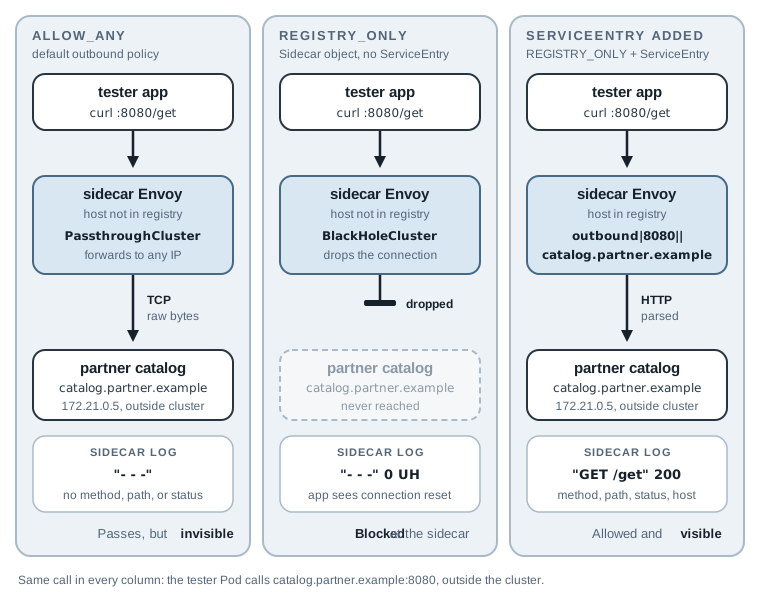
Allowed, and now a real HTTP log line: method, path, status, host, and a named cluster,
outbound|8080||catalog.partner.example. Because the sidecar now parses these calls as HTTP,
the tools from chapters 8 and 9 apply to this host: you could set a timeout, retries, or outlier
detection on calls to the partner. Its calls are also counted in the sidecar’s request metrics
under the partner’s host name, the metrics chapter 13 explains.
The figure puts the three states side by side: the same call passed through as TCP, dropped, and then allowed as HTTP.
|  |
One Exit Point: the Egress Gateway
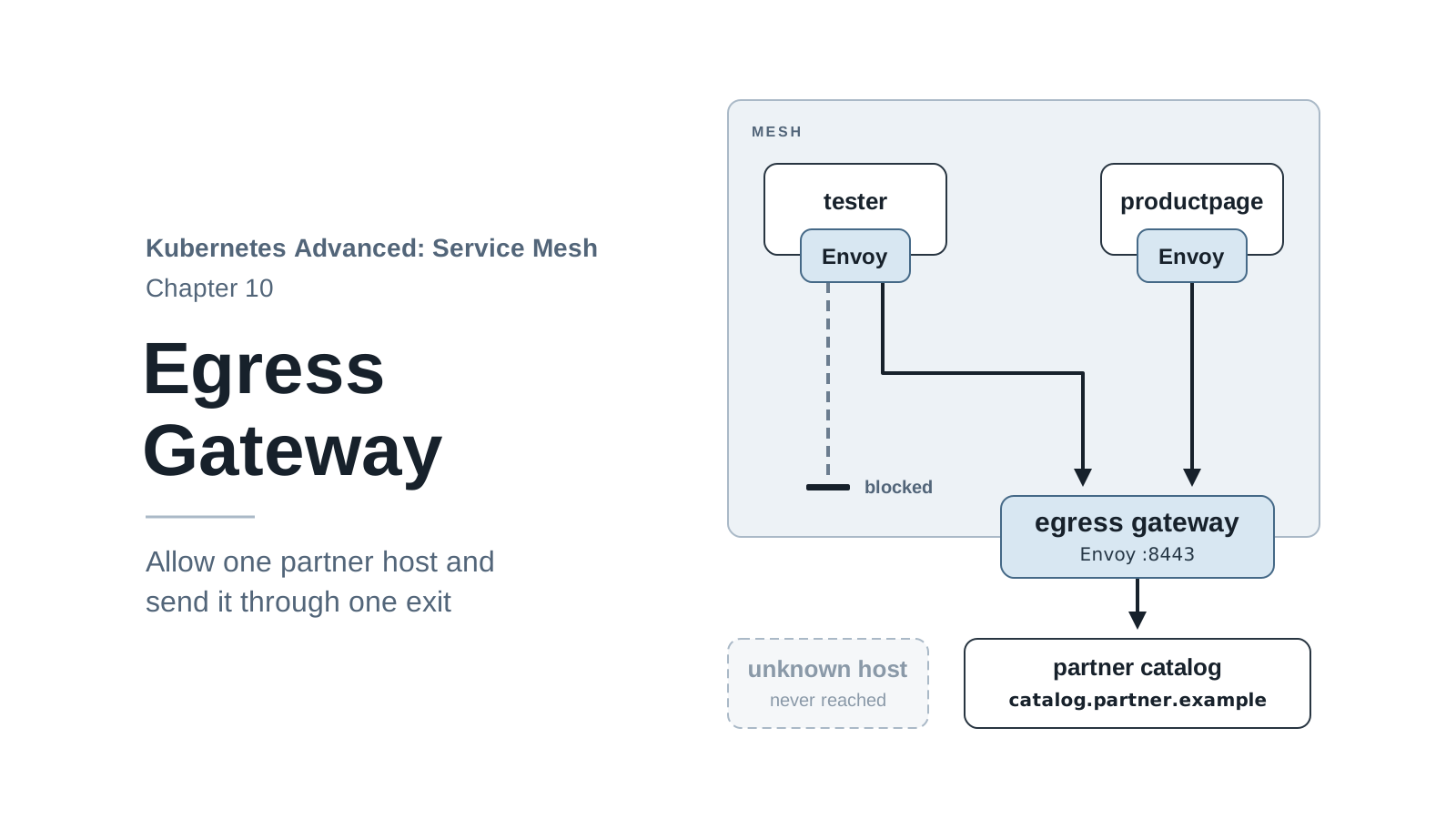
Right now each Pod calls the partner directly from its own node. The security team wants every
call to leave through one place. The egress gateway, which chapter 2’s install created and
nothing has used yet, is an Envoy that serves as that place. It’s the mirror image of the
ingress gateway from chapter 3, configured with the same Gateway and VirtualService objects.
Getting traffic through it takes two hops, and one VirtualService describes both:
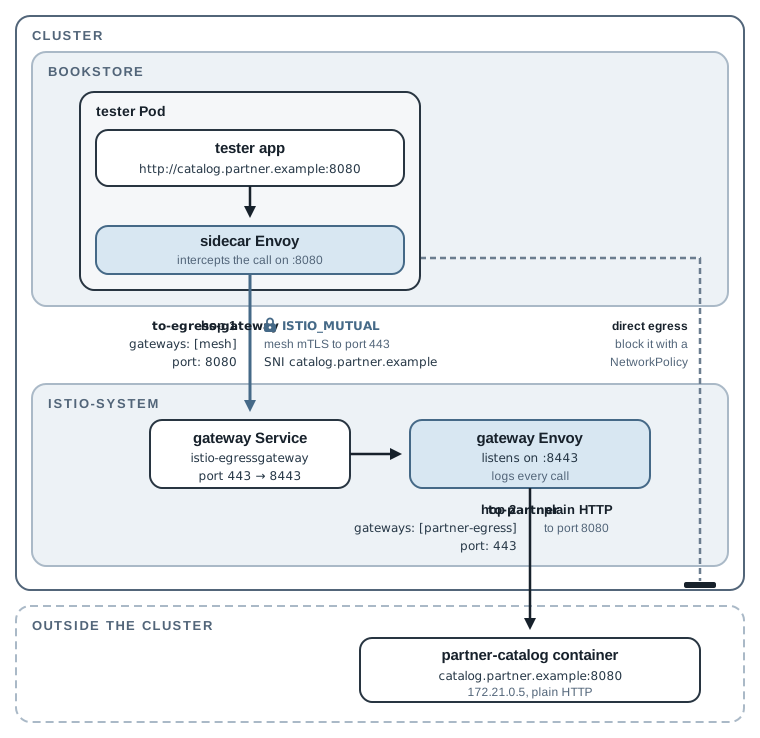
The figure shows where this section ends up, with mesh mTLS on the first hop (port 443). The first version below uses plain HTTP on port 80 for that hop, and the next section secures it.
10-egress/egress-gateway.yaml (first version):
apiVersion: networking.istio.io/v1
kind: Gateway
metadata:
  name: partner-egress
  namespace: bookstore
spec:
  selector:
    istio: egressgateway
  servers:
    - port:
        number: 80
        name: http
        protocol: HTTP
      hosts:
        - catalog.partner.example
---
apiVersion: networking.istio.io/v1
kind: VirtualService
metadata:
  name: partner-catalog
  namespace: bookstore
spec:
  hosts:
    - catalog.partner.example
  gateways:
    - mesh
    - partner-egress
  http:
    - name: to-egress-gateway
      match:
        - gateways:
            - mesh
          port: 8080
      route:
        - destination:
            host: istio-egressgateway.istio-system.svc.cluster.local
            port:
              number: 80
    - name: to-partner
      match:
        - gateways:
            - partner-egress
          port: 80
      route:
        - destination:
            host: catalog.partner.example
            port:
              number: 8080
- The
Gatewayselects the egress gateway Pods by their label,istio: egressgateway, and opens port 80 of their Service for the partner’s host name. As with the ingress gateway in chapter 3, Envoy listens on the Pod port behind it, 8080. - The
VirtualServiceis attached to two gateways at once.meshmeans “the sidecars”, as in chapter 6.partner-egressis the egress gateway. - Rule
to-egress-gatewaymatches only at the sidecars (gateways: [mesh]), for calls to port 8080, and sends them to the egress gateway’s Service. The Service is in another namespace, so the destination uses its full name. - Rule
to-partnermatches only at the egress gateway, on its port 80, and sends the call to the real partner on port 8080.
The gateways condition in each match is what keeps the two hops apart. In this file the
ports differ as well (8080 at the sidecar, 80 at the gateway), but often they don’t: an app
calls a partner on port 80, and the gateway listens on 80 too. Then a rule without gateways
matches at both places, and the egress gateway sends the request back to itself. Always pin
each rule to its gateway.
The Gateway host is the full name catalog.partner.example. I first tried naming the container
partner-catalog and using that short name, and kubectl apply rejected the Gateway with
short names (non FQDN) are not allowed. External hosts on a Gateway need a fully qualified
name, which is why the container has a network alias with dots in it.
kubectl apply -f 10-egress/egress-gateway.yaml
kubectl -n bookstore exec deploy/tester -c tester -- \
  curl -s -o /dev/null -w "%{http_code}\n" http://catalog.partner.example:8080/get
kubectl -n bookstore logs deploy/tester -c istio-proxy --tail=1
kubectl -n istio-system logs deploy/istio-egressgateway --tail=1
gateway.networking.istio.io/partner-egress created
virtualservice.networking.istio.io/partner-catalog created
200
[2026-11-17T01:56:42.385Z] "GET /get HTTP/1.1" 200 - via_upstream - "-" 0 1384 7 6 "-" "curl/8.16.0" "f9062be7-d114-4b04-9615-840fdb46ecfe" "catalog.partner.example:8080" "10.244.2.5:8080" outbound|80||istio-egressgateway.istio-system.svc.cluster.local 10.244.2.25:37854 172.21.0.5:8080 10.244.2.25:60806 - to-egress-gateway
[2026-11-17T01:56:42.386Z] "GET /get HTTP/2" 200 - via_upstream - "-" 0 1384 3 2 "10.244.2.25" "curl/8.16.0" "f5f57bef-8ecb-4d29-9292-ed764a993154" "catalog.partner.example:8080" "172.21.0.5:8080" outbound|8080||catalog.partner.example 10.244.2.5:48544 10.244.2.5:8080 10.244.2.25:37854 - to-partner
Read the two lines as the two hops. The rule name at the end of each line says which rule
handled it. The tester’s sidecar matched to-egress-gateway and sent the call to
10.244.2.5:8080, the egress gateway Pod. The egress gateway matched to-partner and sent it to
172.21.0.5:8080, the partner. Its x-forwarded-for field holds the tester Pod’s IP,
10.244.2.25, so the gateway’s log records which Pod made each call. That log is the audit trail
the security team asked for.
Secure the Hop to the Gateway: ISTIO_MUTUAL
The first hop, from the sidecar to the egress gateway, is plain HTTP on port 80. The gateway’s
log line above shows it: the field just before the rule name, where the SNI of a TLS connection
goes, is -. Inside the mesh that’s a weak spot. The gateway can’t prove who called it (an IP
in x-forwarded-for is only a claim), and the request crosses the cluster network unencrypted.
Chapter 4 mentioned the fix, the ISTIO_MUTUAL TLS mode: the sidecar and the gateway
authenticate each other with the certificates istiod gives every proxy (chapter 11 explains
those certificates).
10-egress/egress-gateway-mtls.yaml replaces the first version. It changes the Gateway server,
adds a DestinationRule, and changes the two VirtualService rules (the file has the complete
objects):
# Gateway partner-egress: the server moves to port 443 and requires mesh mTLS
# ... apiVersion, kind, and metadata as in egress-gateway.yaml
spec:
  # ... selector as in egress-gateway.yaml
  servers:
    - port:
        number: 443
        name: https
        protocol: HTTPS
      hosts:
        - catalog.partner.example
      tls:
        mode: ISTIO_MUTUAL
---
# DestinationRule (new): how sidecars connect to the egress gateway for this host
apiVersion: networking.istio.io/v1
kind: DestinationRule
metadata:
  name: egressgateway-for-partner
  namespace: bookstore
spec:
  host: istio-egressgateway.istio-system.svc.cluster.local
  subsets:
    - name: partner-catalog
      trafficPolicy:
        portLevelSettings:
          - port:
              number: 443
            tls:
              mode: ISTIO_MUTUAL
              sni: catalog.partner.example
---
# VirtualService partner-catalog: hop 1 goes to that subset on port 443; hop 2 matches 443
# ... apiVersion, kind, and metadata as in egress-gateway.yaml
spec:
  # ... hosts and gateways as in egress-gateway.yaml
  http:
    - name: to-egress-gateway
      match:
        - gateways:
            - mesh
          port: 8080
      route:
        - destination:
            host: istio-egressgateway.istio-system.svc.cluster.local
            subset: partner-catalog
            port:
              number: 443
    - name: to-partner
      match:
        - gateways:
            - partner-egress
          port: 443
      route:
        - destination:
            host: catalog.partner.example
            port:
              number: 8080
- The
Gatewayserver moves to port 443 and accepts onlyISTIO_MUTUALconnections: TLS where the client must present a mesh certificate. There’s nocredentialName, because the certificates come fromistiod, not from a Secret. - The
DestinationRuletells sidecars to connect to the egress gateway with mesh mTLS, sending the partner’s name as SNI so the gateway can pick the right server (chapter 4’s SNI matching, from the other side). The settings sit in a subset, so they apply only to traffic that a route sends to that subset, not to every connection to the egress gateway. A second partner would get a subset of its own, with its own SNI. - The
VirtualService’s first rule routes to subsetpartner-catalogof the egress gateway on port 443, and the second rule matches the gateway’s new port, 443.
kubectl apply -f 10-egress/egress-gateway-mtls.yaml
kubectl -n bookstore exec deploy/tester -c tester -- \
  curl -s -o /dev/null -w "%{http_code}\n" http://catalog.partner.example:8080/get
kubectl -n bookstore logs deploy/tester -c istio-proxy --tail=1
kubectl -n istio-system logs deploy/istio-egressgateway --tail=1
gateway.networking.istio.io/partner-egress configured
destinationrule.networking.istio.io/egressgateway-for-partner created
virtualservice.networking.istio.io/partner-catalog configured
200
[2026-11-17T01:57:42.335Z] "GET /get HTTP/1.1" 200 - via_upstream - "-" 0 2956 5 5 "-" "curl/8.16.0" "40b96684-3c75-4ff8-92bc-c894b62da39c" "catalog.partner.example:8080" "10.244.2.5:8443" outbound|443|partner-catalog|istio-egressgateway.istio-system.svc.cluster.local 10.244.2.25:46032 172.21.0.5:8080 10.244.2.25:33176 - to-egress-gateway
[2026-11-17T01:57:42.339Z] "GET /get HTTP/1.1" 200 - via_upstream - "-" 0 2956 1 1 "10.244.2.25" "curl/8.16.0" "abb9adb8-8248-4a37-910a-062db0e678bf" "catalog.partner.example:8080" "172.21.0.5:8080" outbound|8080||catalog.partner.example 10.244.2.5:55940 10.244.2.5:8443 10.244.2.25:46032 catalog.partner.example to-partner
The app still calls plain http://catalog.partner.example:8080; nothing changed for it. The first
hop now goes to the gateway Pod’s port 8443 (the Pod port behind Service port 443) through the
cluster outbound|443|partner-catalog|istio-egressgateway..., the subset with mesh mTLS. The
gateway’s line now shows the SNI it received, catalog.partner.example, where the first version
had -.
The last hop, from the gateway to the partner, is still plain HTTP, because this partner speaks
plain HTTP. A real partner API would use HTTPS. The egress gateway can then originate TLS for
that last hop: a DestinationRule for the partner’s host with tls.mode: SIMPLE makes the
gateway open the TLS connection itself. Apps keep sending plain HTTP inside the mesh, and the
gateway encrypts on the way out. (I didn’t run this variant here, because the lab partner has
no HTTPS port.)
Note: The egress gateway is an exit point by convention, not a wall. The routing rules live in the sidecars, so a Pod without a sidecar never sees them (chapter 6 showed the same for routing), and neither does a process that gets around its sidecar’s traffic capture. Both can still reach the partner directly. To enforce the exit point, add a Kubernetes NetworkPolicy (or a cloud firewall rule) that allows outbound traffic to external networks only from the egress gateway Pods. Istio’s documentation says the same: the egress gateway needs that second layer.
Break It: The Wrong Protocol in a ServiceEntry
A teammate edits the ServiceEntry and, assuming partner APIs always use TLS, sets the port’s
protocol to HTTPS. The partner on port 8080 speaks plain HTTP:
kubectl -n bookstore patch serviceentry partner-catalog --type=json \
  -p='[{"op":"replace","path":"/spec/ports/0/protocol","value":"HTTPS"},{"op":"replace","path":"/spec/ports/0/name","value":"https"}]'
kubectl -n bookstore exec deploy/tester -c tester -- \
  curl -sS -o /dev/null -w "%{http_code}\n" http://catalog.partner.example:8080/get
kubectl -n bookstore logs deploy/tester -c istio-proxy --tail=1
istioctl analyze -n bookstore
serviceentry.networking.istio.io/partner-catalog patched
curl: (56) Recv failure: Connection reset by peer
000
command terminated with exit code 56
[2026-11-17T01:59:36.664Z] "- - -" 0 UH - - "-" 0 0 0 - "-" "-" "-" "-" "-" BlackHoleCluster - 172.21.0.5:8080 10.244.2.26:37588 - -
✔ No validation issues found when analyzing namespace: bookstore.
The call fails exactly as if there were no ServiceEntry at all: BlackHoleCluster. (I ran
this section a second time, so the tester Pod’s IP differs from earlier lines.) The
request never left the tester’s sidecar, so it never reached the egress gateway, and the
VirtualService routes didn’t run. And analyze is happy, because the configuration is valid;
it’s just wrong about the partner.
The clue is in the sidecar’s listener for port 8080:
istioctl proxy-config listener deploy/tester -n bookstore --port 8080
ADDRESSES PORT MATCH                        DESTINATION
0.0.0.0   8080 ALL                          Non-HTTP/Non-TCP
0.0.0.0   8080 SNI: catalog.partner.example Cluster: outbound|8080||catalog.partner.example
With protocol: HTTPS, the sidecar expects TLS on port 8080 and picks the destination by the SNI
in the TLS handshake, the same way chapter 4’s gateway did for PASSTHROUGH. curl sends plain HTTP,
which has no SNI, so nothing matches and REGISTRY_ONLY sends it to the black hole. Put the
protocol back and the listener parses HTTP again:
kubectl -n bookstore patch serviceentry partner-catalog --type=json \
  -p='[{"op":"replace","path":"/spec/ports/0/protocol","value":"HTTP"},{"op":"replace","path":"/spec/ports/0/name","value":"http"}]'
istioctl proxy-config listener deploy/tester -n bookstore --port 8080
kubectl -n bookstore exec deploy/tester -c tester -- \
  curl -s -o /dev/null -w "%{http_code}\n" http://catalog.partner.example:8080/get
serviceentry.networking.istio.io/partner-catalog patched
ADDRESSES PORT MATCH                                DESTINATION
0.0.0.0   8080 Trans: raw_buffer; App: http/1.1,h2c Route: 8080
0.0.0.0   8080 ALL                                  Non-HTTP/Non-TCP
200
The HTTP row is back, and the call returns 200. The rule to take from this: the protocol in a
ServiceEntry describes what the client sends to the sidecar, not what the partner advertises.
An app that speaks plain HTTP needs HTTP, even if the gateway encrypts the last hop. An app that
does its own TLS needs TLS or HTTPS. istioctl analyze can’t catch a mismatch, because it
doesn’t know what the app sends; istioctl proxy-config listener shows what the sidecar expects.
Reset Before the Next Chapter
Remove everything from this chapter, including the partner container:
kubectl delete -f 10-egress/egress-gateway-mtls.yaml -f 10-egress/serviceentry-partner-catalog.yaml \
  -f 10-egress/sidecar-registry-only.yaml -f 10-egress/tester.yaml
docker rm -f partner-catalog
gateway.networking.istio.io "partner-egress" deleted
destinationrule.networking.istio.io "egressgateway-for-partner" deleted
virtualservice.networking.istio.io "partner-catalog" deleted
serviceentry.networking.istio.io "partner-catalog" deleted
sidecar.networking.istio.io "default" deleted
serviceaccount "tester" deleted
deployment.apps "tester" deleted
partner-catalog
kind delete cluster doesn’t remove the container, because it isn’t part of the cluster, and
--restart unless-stopped starts it again with Docker. So remove it yourself if you skip this
step. To rebuild the starting state of chapter 11 from scratch: ./scripts/bootstrap.sh 11.
Summary
- By default (
ALLOW_ANY), a sidecar forwards calls to unknown hosts as anonymous TCP throughPassthroughCluster.REGISTRY_ONLYdrops them inBlackHoleCluster; aSidecarobject sets it per namespace. - A
ServiceEntryadds an external host to the registry. Withprotocol: HTTP, its calls become full HTTP requests with routing, retries, metrics, and log lines. - An egress gateway is an exit point. One
VirtualServicebound tomeshand to the egressGatewayroutes the two hops, withmatch.gatewaysdeciding which rule applies where. ISTIO_MUTUALon the egressGatewayplus aDestinationRuleencrypts and authenticates the hop from the sidecar to the gateway. Enforcing the exit point also needs a NetworkPolicy or firewall.- A
ServiceEntryport protocol must match what the client sends. A wrong one fails like a missingServiceEntry,istioctl analyzedoesn’t notice, andistioctl proxy-config listenershows why. Next, chapter 11 covers mutual TLS between the services inside the mesh, and the certificates behind it.