Chapter 6 moved traffic to reviews v3 by percentage. A percentage is the right tool once a
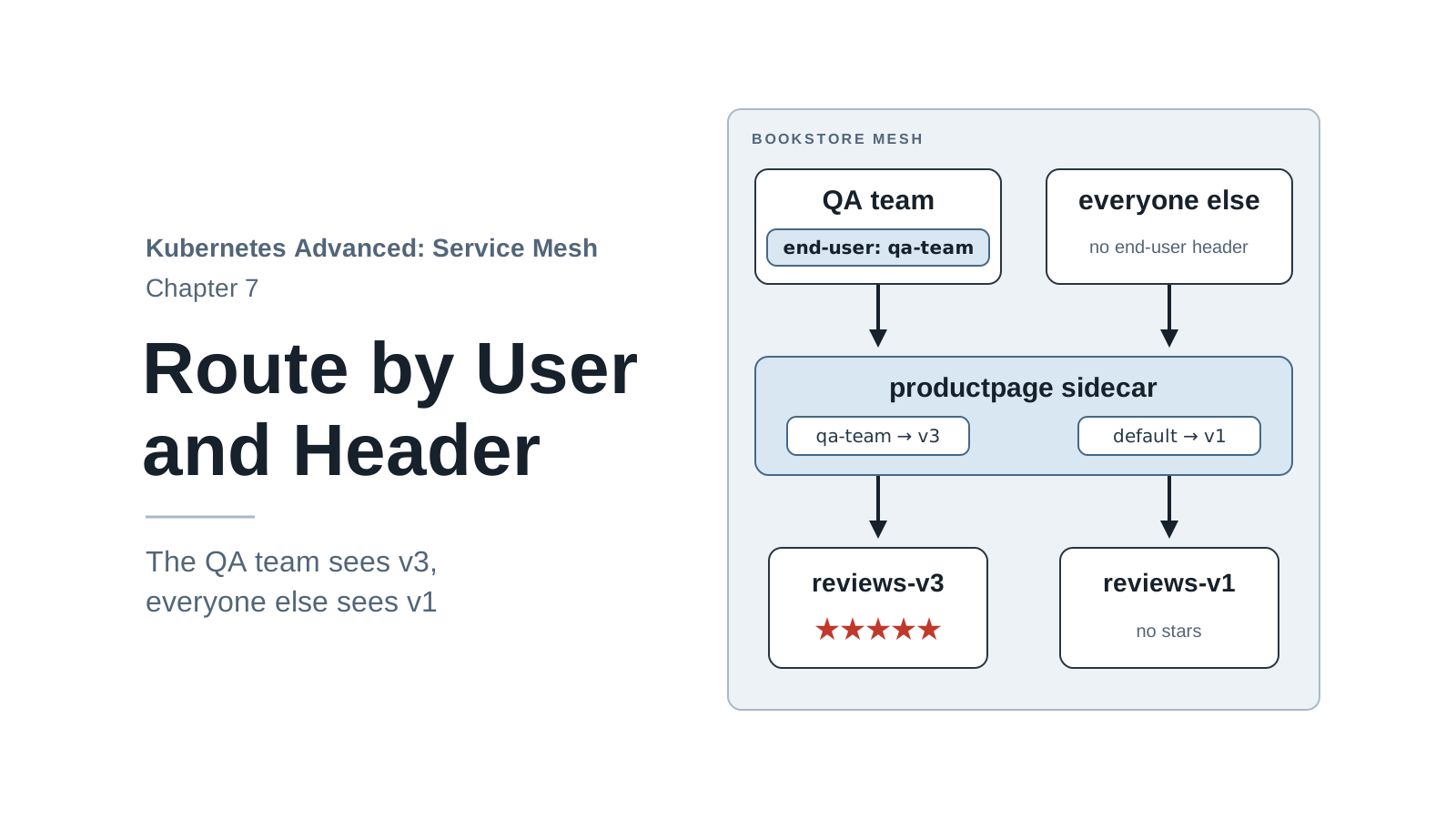
version is ready for real users. Before that, a team usually wants something narrower: the QA
team should see v3 in production, with real data and real dependencies, while every customer
keeps seeing v1. A random 10% can’t do that, and as chapter 6 showed, it can’t even keep one
user on the same version from one page load to the next. Routing by who sends the request does
both.
Istio can match a request on its path, method, query parameters, and headers, and cookies travel
in the Cookie header. The QA case is a header match, and that part is easy. The part that
catches teams out is which headers exist at the proxy that makes the decision. In Book Store that
proxy is productpage’s sidecar, and it sees only the headers that productpage puts on its call
to reviews. This chapter shows a match that works, a match that can never fire, and why.
By the end of this chapter you will:
- Route one user to
reviewsv3 with a header match, and everyone else to v1. - Read the rules Envoy built from the match with
istioctl proxy-config route. - Explain header propagation: why a header has to be forwarded by the app for a sidecar one hop later to see it.
- Fix a routing rule that never fires, without changing the app’s code.
Code for this chapter. The files are in _resource/kubernetes-service-mesh/07-header-routing. I tested them with Kind v0.33.0 (Kubernetes v1.37.0) and Istio 1.32.0 on macOS with Docker Desktop, and the command output in this chapter comes from those runs.
Starting Point
Run every command from _resource/kubernetes-service-mesh, with the series’ istioctl on your
PATH:
export PATH="$PWD/bin:$PATH"
The chapter needs the reviews DestinationRule from chapter 6 (subsets v1, v2, v3) and no
VirtualService for reviews. That’s the state chapter 6’s reset left. To build it from
scratch:
./scripts/bootstrap.sh 07
How Book Store Knows Who You Are
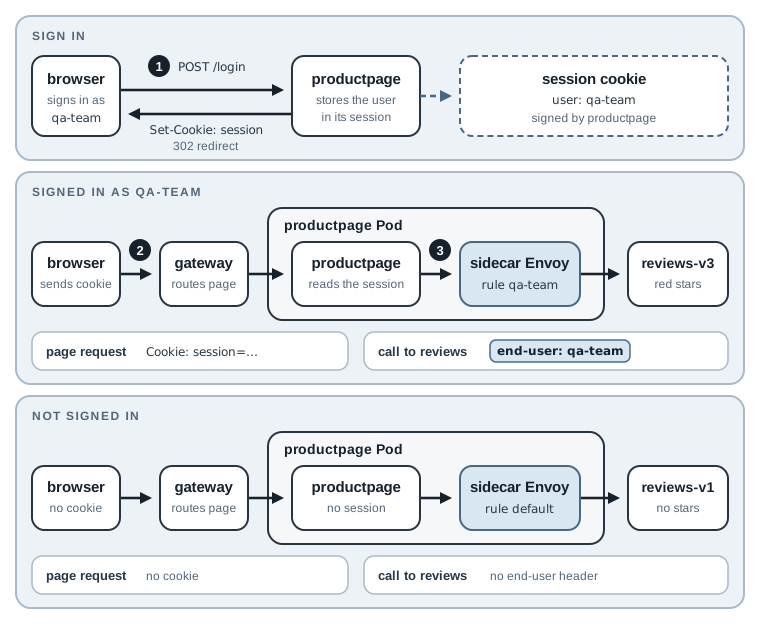
Book Store has a “Sign in” button. It doesn’t check passwords; any name works. Behind it,
productpage handles POST /login: it stores the user name in its session, a cookie signed by
the server, and redirects back to the page you came from. From then on, every call productpage
makes to another service, reviews included, carries a header with that name:
end-user: qa-team
The header comes from productpage’s Python code, not from the browser or from Istio. A function
called getForwardHeaders builds the headers for every outgoing call: end-user from the
session, plus a fixed list of headers copied from the incoming request (x-request-id, the
tracing headers, user-agent, cookie, authorization, and jwt). Any other header on the
incoming request stays behind. Remember that list; the second half of the chapter depends on it.
end-user itself isn’t on the copy list. productpage sets it only from the session, so a
client that sends its own end-user header can’t choose a version that way.
Send the QA Team to v3
07-header-routing/virtualservice-reviews-qa.yaml:
apiVersion: networking.istio.io/v1
kind: VirtualService
metadata:
  name: reviews
  namespace: bookstore
spec:
  hosts:
    - reviews
  http:
    - name: qa-team
      match:
        - headers:
            end-user:
              exact: qa-team
      route:
        - destination:
            host: reviews
            subset: v3
    - name: default
      route:
        - destination:
            host: reviews
            subset: v1
Two rules, checked in order:
qa-teammatches when the request has anend-userheader whose value is exactlyqa-team, and sends it to subset v3. Besidesexact, a header match can useprefixorregex. Istio requires the header name in a match to be lowercase.defaulthas nomatch, so it matches everything. It must come last: a rule without a match placed first would catch every request, and the rules after it would never run.
Apply it and send requests without signing in:
kubectl apply -f 07-header-routing/virtualservice-reviews-qa.yaml
./scripts/count-versions.sh http://bookstore.local:8080 20
virtualservice.networking.istio.io/reviews created
  20 200 reviews-v1 no-stars fast
Everyone without a name gets v1. Now sign in as qa-team with curl. -d posts the sign-in form;
productpage reads username and ignores the password. -c saves the session cookie from the
response to a file, the way a browser stores it:
curl -s --resolve bookstore.local:8080:127.0.0.1 -c /tmp/qa-cookies.txt \
  -d 'username=qa-team&passwd=anything' -o /dev/null -w "%{http_code}\n" \
  http://bookstore.local:8080/login
302
302 is the redirect that /login sends after it stores the name. Send the same requests with
the cookie. CURL_OPTS passes extra options to every curl the script runs, and -b with a file
name sends the cookies saved in that file:
CURL_OPTS="-b /tmp/qa-cookies.txt" ./scripts/count-versions.sh http://bookstore.local:8080 20
20 200 reviews-v3 stars fast
All 20 went to v3. In a browser (with the hosts entry from chapter 3), open
http://bookstore.local:8080/productpage, click “Sign in”, and enter qa-team with any
password. The reviews show red stars on every refresh. Sign out, and they go back to no stars.
The decision happened in productpage’s sidecar, as in chapter 6. It received the outgoing call
with end-user: qa-team and matched it. The route table shows the rules it built. As in
chapter 6, the Python snippet trims the JSON, this time to each reviews route’s name, header
match, and destination cluster:
istioctl proxy-config route deploy/productpage-v1 -n bookstore --name 9080 -o json | python3 -c '
import json, sys
for rc in json.load(sys.stdin):
    for vh in rc["virtualHosts"]:
        if vh["name"].startswith("reviews."):
            for r in vh["routes"]:
                print(r.get("name"), json.dumps(r["match"].get("headers", [])), r["route"]["cluster"])'
qa-team [{"name": "end-user", "stringMatch": {"exact": "qa-team"}}] outbound|9080|v3|reviews.bookstore.svc.cluster.local
default [] outbound|9080|v1|reviews.bookstore.svc.cluster.local
One Envoy route per rule, in the same order, each pointing at a subset’s cluster. Envoy uses the first route that matches, so the order you write in YAML is the order the sidecar checks.
The figure follows the whole path, from the sign-in to the routing decision:
A rule like this is only as trustworthy as the code that sets the header. Book Store’s sign-in
has no password, so anyone can call themselves qa-team. In your own apps, route on a header
that the app derives from a real login, not on one a client can set directly.
Break It: A Header That Never Arrives
The QA rule depends on a login. The team also wants a simpler switch for developers testing
from the command line: send x-bookstore-preview: true with any request, and see v3.
07-header-routing/virtualservice-reviews-preview-header.yaml adds a rule between the two:
    - name: preview-header
      match:
        - headers:
            x-bookstore-preview:
              exact: "true"
      route:
        - destination:
            host: reviews
            subset: v3
("true" is quoted so YAML reads it as text, not a boolean.) Apply it and send the header. The
script splits CURL_OPTS on spaces, so the header has no space after the colon:
kubectl apply -f 07-header-routing/virtualservice-reviews-preview-header.yaml
CURL_OPTS='-H x-bookstore-preview:true' ./scripts/count-versions.sh http://bookstore.local:8080 20
virtualservice.networking.istio.io/reviews configured
  20 200 reviews-v1 no-stars fast
v1, every time. The rule itself is valid: istioctl analyze -n bookstore reports no issues, and
productpage’s sidecar has the preview-header route. To test the rule on its own, call
reviews from a test Pod inside the mesh and put the header on that call yourself. The
bookstore namespace has injection on, so the test Pod gets a sidecar, and every sidecar in the
mesh receives the same reviews routes as productpage’s:
kubectl -n bookstore run tester --image=docker.io/curlimages/curl:8.16.0 \
  --restart=Never --command -- sleep 3600
kubectl -n bookstore wait --for=condition=Ready pod/tester --timeout=90s
kubectl -n bookstore exec tester -c tester -- sh -c 'for i in 1 2 3 4 5; do
  curl -s -H "x-bookstore-preview: true" http://reviews:9080/reviews/0 | grep -o "reviews-v[0-9]"
done | sort | uniq -c'
pod/tester created
pod/tester condition met
      5 reviews-v3
-c tester picks the app container; the Pod also has istio-proxy. All five calls went to v3.
The test Pod’s own sidecar made the decision, with the same rules, on a request that carried the
header. So the rule works when the header is on the call it inspects. Through Book Store, the
header isn’t there.
Follow the header. curl sends x-bookstore-preview: true to the gateway. The gateway routes on
host and path and forwards the request, header included, to productpage. The productpage
app receives it. Then the app makes a new HTTP request to reviews, and builds that request’s
headers with getForwardHeaders. x-bookstore-preview isn’t on its list, so the new request
doesn’t carry it. productpage’s sidecar matches rules against that new request, finds no
header, and uses the default.
The top half of the figure shows that path. The bottom half is the fix from the next section.
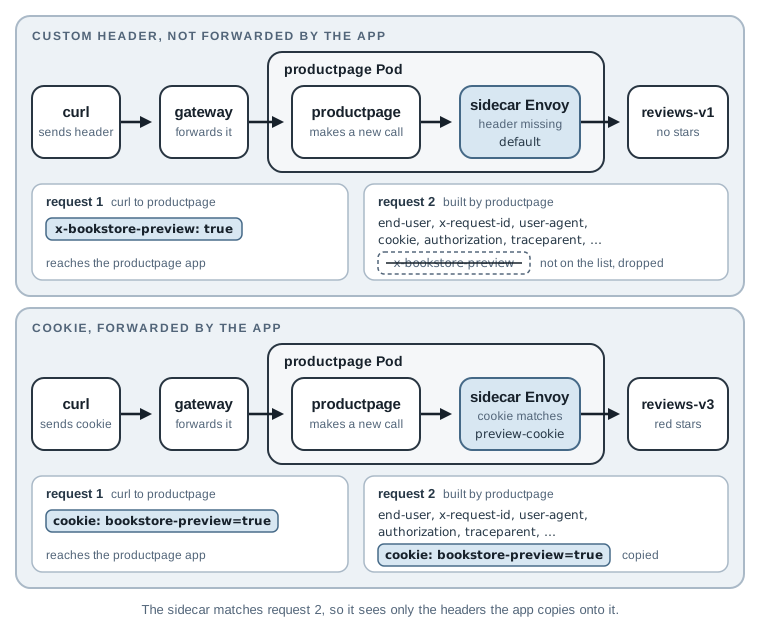
This is header propagation: the app copying headers from the request it received onto the
requests it sends. It’s a basic limit of a sidecar mesh. The sidecar sees each request, but it
can’t tell which outgoing requests the app made because of which incoming one. Only the app knows
that. So any header that a routing rule matches one or more hops downstream must be copied by
every app in between. Chapter 13 meets the same limit with tracing headers, which is why most of
productpage’s list is tracing headers.
Fix It Without Changing the Code
The proper fix is to add x-bookstore-preview to productpage’s forward list. That’s a code
change and a release, often in another team’s service. Until it ships, a header the app already
forwards can carry the signal. productpage forwards cookie, so a cookie the client sends
reaches the reviews call. Match on that instead.
07-header-routing/virtualservice-reviews-preview-cookie.yaml replaces the header rule with:
    - name: preview-cookie
      match:
        - headers:
            cookie:
              regex: "^(.*;\\s*)?bookstore-preview=true(;.*)?$"
      route:
        - destination:
            host: reviews
            subset: v3
A Cookie header holds all cookies in one string, such as
theme=dark; bookstore-preview=true, so the rule uses a regex. It finds
bookstore-preview=true at the start of the header or after a ;, followed by another ; or
the end. A longer cookie name such as old-bookstore-preview, or a value such as true2, doesn’t
match. (In the YAML string, \\s becomes the regex \s, any whitespace.)
Apply it and test three cases. -b with name=value text, instead of a file name, sends that
text as the cookie. The second case has no space after the ; because the script splits
CURL_OPTS on spaces; the \s* in the regex covers the ; that browsers send.
kubectl apply -f 07-header-routing/virtualservice-reviews-preview-cookie.yaml
CURL_OPTS='-b bookstore-preview=true' ./scripts/count-versions.sh http://bookstore.local:8080 20
CURL_OPTS='-b theme=dark;bookstore-preview=true' ./scripts/count-versions.sh http://bookstore.local:8080 5
CURL_OPTS='-b bookstore-preview=false' ./scripts/count-versions.sh http://bookstore.local:8080 5
virtualservice.networking.istio.io/reviews configured
  20 200 reviews-v3 stars fast
   5 200 reviews-v3 stars fast
   5 200 reviews-v1 no-stars fast
The cookie works alone and after another cookie, and false gets v1. A developer can now set the
cookie in the browser’s developer tools and preview v3 without signing in.
The fix has costs. The match depends on a list in someone else’s code: if the productpage team
ever stops forwarding cookies, the rule silently stops firing, exactly like the broken header
rule, and istioctl analyze won’t notice. A regex over the whole Cookie header is easy to get
subtly wrong, so test the variants as above. And anyone who knows the cookie name can opt in.
That’s fine for previewing a new star color, not for a feature that must stay private. For
anything long-lived, add the header to the app’s forward list and match it exactly.
Note: Matching at the gateway avoids the propagation problem, but only for the first hop. The gateway sees every header the client sends, so a gateway
VirtualServicecould route onx-bookstore-previewto a secondproductpageversion, given aDestinationRulewithproductpagesubsets. (Book Store runs onlyproductpagev1, so this chapter doesn’t try it.) The gateway can’t choose areviewsversion, because that choice is made inproductpage’s sidecar.
Reset Before the Next Chapter
Delete the VirtualService and the test Pod, and keep the DestinationRule:
kubectl delete virtualservice reviews -n bookstore
kubectl -n bookstore delete pod tester
rm -f /tmp/qa-cookies.txt
To rebuild the starting state of chapter 8 from scratch: ./scripts/bootstrap.sh 08.
Summary
- A
VirtualServicerule canmatchon headers withexact,prefix, orregex. Rules run in order; put the default rule, with no match, last. productpageaddsend-user: <name>to its outgoing calls after a sign-in, so a match onend-user: qa-teamsends the QA team to v3 while everyone else gets v1. The rule is only as trustworthy as the code that sets the header.- The routing decision for
reviewshappens inproductpage’s sidecar, on the requestproductpagebuilds. A header the app doesn’t copy onto that request can’t be matched, andistioctl analyzecan’t warn you. - Forward every header you route on, in every app along the path. Without a code change, match a
header the app already forwards, such as
cookie, and accept that the rule depends on the app’s code and that anyone can set the cookie. - Next, chapter 8 deals with slow and failing calls: timeouts, retries, and fault injection.