Chapter 11 made every connection inside bookstore mutually authenticated. Each sidecar now
knows exactly who is calling: spiffe://cluster.local/ns/bookstore/sa/bookstore-productpage,
not just an IP. But knowing who is calling isn’t the same as deciding whether they may. Any
workload with a sidecar in any namespace can still call ratings, and nothing stops a
compromised details Pod from calling reviews.
This chapter adds that decision. An AuthorizationPolicy says which identities may call which
workload, with which methods and paths. The usual pattern is default deny: block everything,
then allow exactly the calls the app makes. The second half of the chapter protects something
humans use: an admin API for changing ratings, exposed through the ingress gateway and open only
to requests that carry a valid signed token (a JWT) with the right role.
By the end of this chapter you will:
- Lock
bookstoredown with a default-deny policy and allow Book Store’s four calls by identity. - Read a denial in the access log (
rbac_access_denied_matched_policy) and find which policy caused it. - Explain the order in which Istio evaluates
CUSTOM,DENY, andALLOWpolicies. - Validate JWTs at the gateway with a
RequestAuthentication, and require a role claim with aDENYpolicy.
Code for this chapter. The files are in _resource/kubernetes-service-mesh/12-authorization, and the token script is
scripts/make-jwt.sh. I tested them with Kind v0.33.0 (Kubernetes v1.37.0) and Istio 1.32.0 on macOS with Docker Desktop, and the command output in this chapter comes from those runs.
Starting Point
Run every command from _resource/kubernetes-service-mesh:
export PATH="$PWD/bin:$PATH"
The chapter needs chapter 11’s end state: Book Store at http://bookstore.local:8080, with
STRICT mTLS in bookstore. Authorization by identity depends on mTLS: without a client
certificate, there is no identity to check. To build the state from scratch:
./scripts/bootstrap.sh 12
How Istio Evaluates a Request
An AuthorizationPolicy is enforced by the sidecar (or gateway) of the workload it selects, for
every request that workload receives. Each policy has an action, and the sidecar evaluates them
in a fixed order:
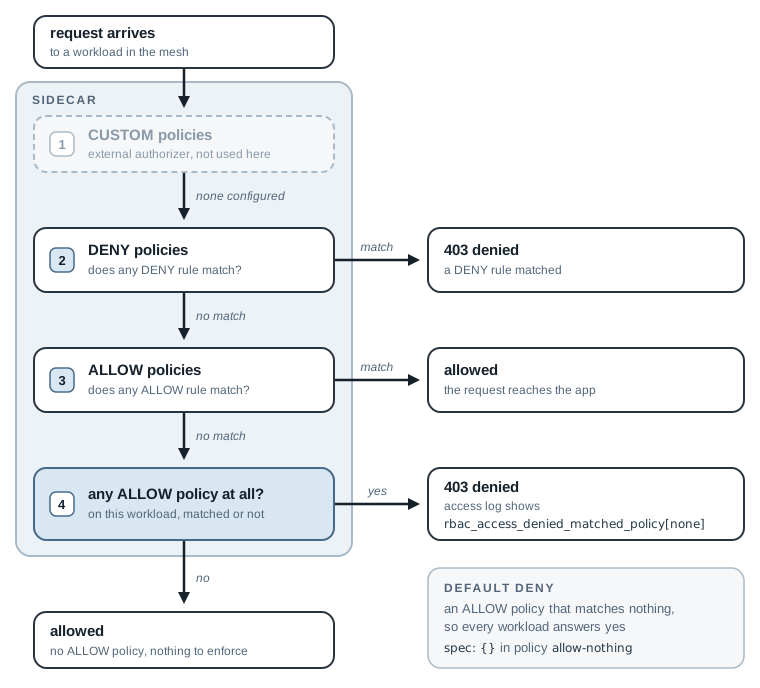
CUSTOMpolicies, which ask an external authorization service. (Not used in this series.)DENYpolicies. If any matches, the request is denied.ALLOWpolicies. If any matches, the request is allowed.- If the workload has at least one
ALLOWpolicy and none matched, the request is denied. If it has noALLOWpolicy at all, the request is allowed.
Rule 4 is the one that surprises people: adding your first ALLOW policy to a workload silently
denies everything that policy doesn’t mention. It’s also how default deny works.
Default Deny
12-authorization/deny-all.yaml:
apiVersion: security.istio.io/v1
kind: AuthorizationPolicy
metadata:
  name: allow-nothing
  namespace: bookstore
spec: {}
An empty spec means: no selector, so it applies to every workload in bookstore; the default
action, ALLOW; and no rules, so it matches nothing. By rule 4, every workload now has an
ALLOW policy that matches nothing, so every request is denied.
kubectl apply -f 12-authorization/deny-all.yaml
curl -s -w " %{http_code}\n" --resolve bookstore.local:8080:127.0.0.1 http://bookstore.local:8080/productpage
./scripts/count-versions.sh http://bookstore.local:8080 5
authorizationpolicy.security.istio.io/allow-nothing created
RBAC: access denied 403
   5 403 reviews-none - fast
RBAC: access denied is the body Envoy returns for a denied request. (Istio’s authorization was
once called RBAC, role-based access control, and the name stuck in Envoy.)
Give the policy a few seconds before you trust the result. istiod pushes it to each sidecar
separately, so for a moment some sidecars enforce it and others don’t. In my first try, the page
came back 200 with “Error fetching product details”: details had the policy already and
refused productpage, but productpage hadn’t received it yet and still let the gateway in.
The sidecar that refuses a request logs it. Every request from count-versions.sh enters through
productpage, which now refuses it, so read that sidecar’s last line:
kubectl -n bookstore logs deploy/productpage-v1 -c istio-proxy --tail=1
[2026-11-17T02:08:47.012Z] "GET /api/v1/products/0/reviews HTTP/1.1" 403 - rbac_access_denied_matched_policy[none] - "-" 0 19 0 - "172.21.0.4" "curl/8.7.1" "a55bc040-6e76-48e3-b12e-0b7e90225bc4" "bookstore.local:8080" "-" inbound|9080|| - 10.244.2.16:9080 172.21.0.4:0 outbound_.9080_._.productpage.bookstore.svc.cluster.local default
rbac_access_denied_matched_policy[none] means “denied, and no policy matched”: the rule 4 case.
When a DENY policy causes a denial, the brackets name it, as you’ll see at the gateway later.
Allow Exactly What Book Store Does
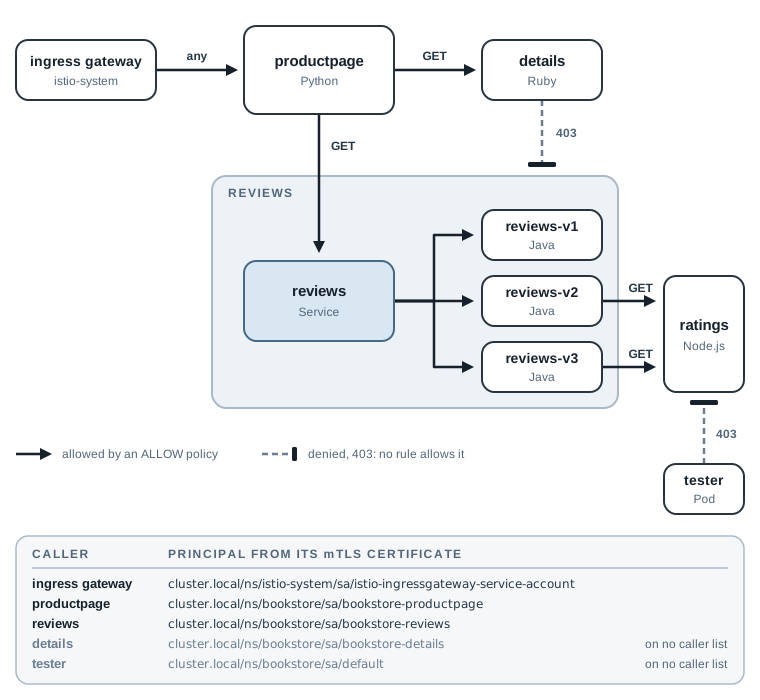
Book Store makes four kinds of calls. 12-authorization/allow-bookstore.yaml has one ALLOW
policy per workload, each naming the only caller allowed in:
| Workload | Allowed caller (principal) | Methods |
|---|---|---|
productpage |
cluster.local/ns/istio-system/sa/istio-ingressgateway-service-account |
any |
details |
cluster.local/ns/bookstore/sa/bookstore-productpage |
GET |
reviews |
cluster.local/ns/bookstore/sa/bookstore-productpage |
GET |
ratings |
cluster.local/ns/bookstore/sa/bookstore-reviews |
GET |
A principal is the identity from chapter 11 without the spiffe:// prefix. The ratings
policy:
apiVersion: security.istio.io/v1
kind: AuthorizationPolicy
metadata:
  name: ratings
  namespace: bookstore
spec:
  selector:
    matchLabels:
      app: ratings
  action: ALLOW
  rules:
    - from:
        - source:
            principals:
              - cluster.local/ns/bookstore/sa/bookstore-reviews
      to:
        - operation:
            methods: ["GET"]
selectorpicks theratingsPods. The policy is enforced by their sidecars.from.source.principalsis who may call. All threereviewsversions run asbookstore-reviews, so one principal covers them.to.operation.methodsis what they may do.reviewsonly reads ratings.
Inside one rule, from and to must both match. Separate rules are alternatives: a request that
matches any one of them is allowed. The productpage policy has no to, so the gateway may send
it any method and path. Apply all four:
kubectl apply -f 12-authorization/allow-bookstore.yaml
./scripts/count-versions.sh http://bookstore.local:8080 20
authorizationpolicy.security.istio.io/productpage created
authorizationpolicy.security.istio.io/details created
authorizationpolicy.security.istio.io/reviews created
authorizationpolicy.security.istio.io/ratings created
   8 200 reviews-v1 no-stars fast
   7 200 reviews-v2 stars fast
   5 200 reviews-v3 stars fast
Book Store works again. (Run it right after the apply and the first requests may still get
403, for the same propagation reason as before.)
Now check that nothing else gets in. Start a test Pod in bookstore. The namespace has
injection on, so the Pod gets a sidecar and a valid mesh identity, just not an allowed one:
kubectl -n bookstore run tester --image=docker.io/curlimages/curl:8.16.0 \
  --restart=Never --command -- sleep 3600
kubectl -n bookstore wait --for=condition=Ready pod/tester --timeout=90s
kubectl -n bookstore exec tester -c tester -- curl -s -w " %{http_code}\n" http://ratings:9080/ratings/0
kubectl -n bookstore exec tester -c tester -- curl -s -w " %{http_code}\n" http://details:9080/details/0
pod/tester created
pod/tester condition met
RBAC: access denied 403
RBAC: access denied 403
A Pod in the right namespace, with mTLS, is still refused, because its identity
(.../sa/default) isn’t on any list. A NetworkPolicy, chapter 1’s partial answer, could keep
tester out too, but it decides per connection, by Pod labels that it turns into IP addresses.
An AuthorizationPolicy checks the identity in the caller’s certificate on every request, and
it can limit the method as well, like the GET in three of the four policies.
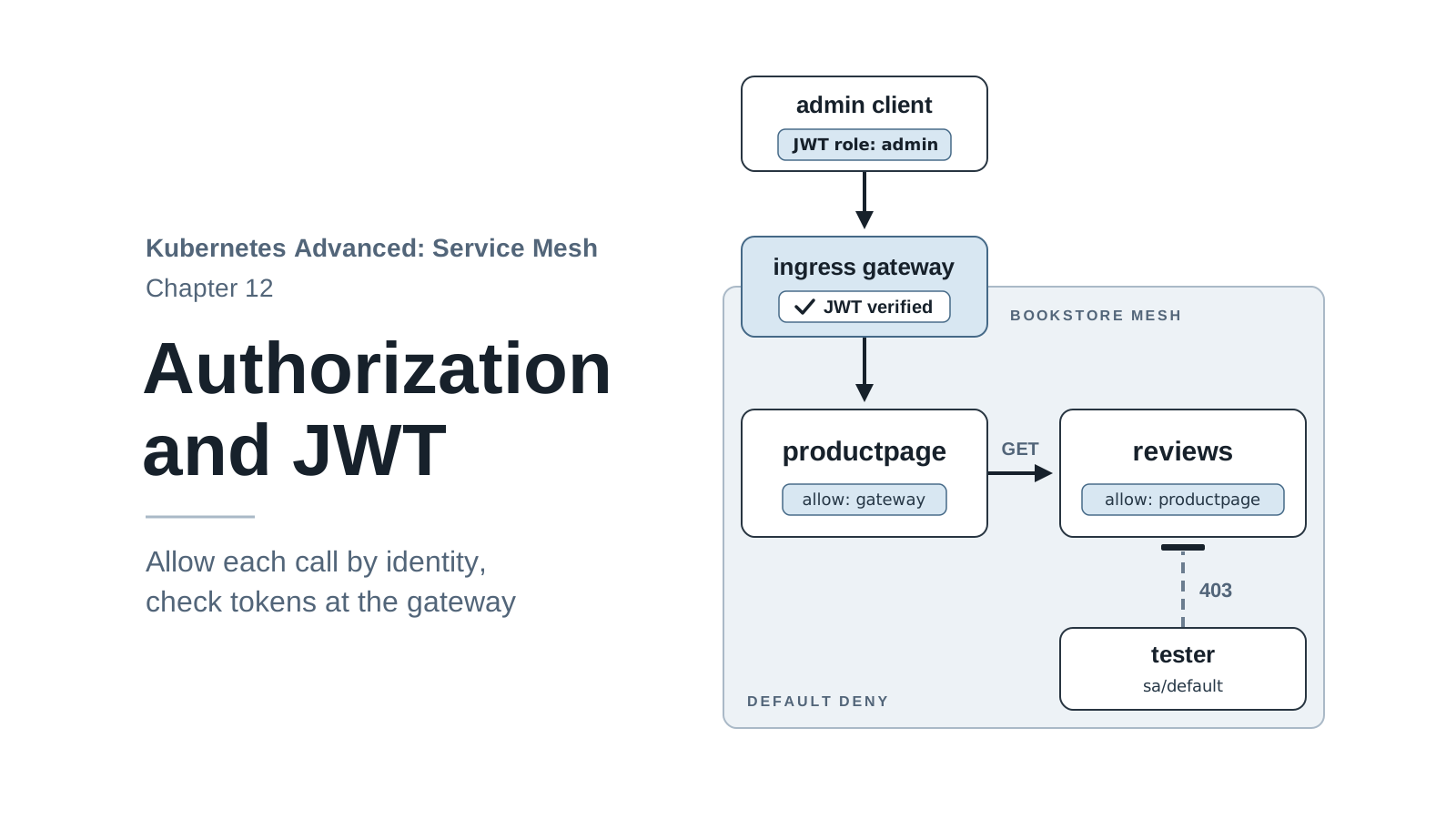
The figure shows what is left: the four kinds of call Book Store makes, and nothing else:
Break It: A Typo in a Service Account
Someone edits the ratings policy and drops one letter from the service account:
bookstore-review instead of bookstore-reviews.
kubectl -n bookstore patch authorizationpolicy ratings --type=json \
  -p='[{"op":"replace","path":"/spec/rules/0/from/0/source/principals/0","value":"cluster.local/ns/bookstore/sa/bookstore-review"}]'
./scripts/count-versions.sh http://bookstore.local:8080 20
authorizationpolicy.security.istio.io/ratings patched
   7 200 reviews-v3 ratings-error fast
   6 200 reviews-v1 no-stars fast
   5 200 reviews-v2 ratings-error fast
   1 200 reviews-v3 stars fast
   1 200 reviews-v2 stars fast
Stars disappear across the site. (The two pages with stars were served while the change was still
reaching the ratings sidecar.) The pages still return 200, as in chapter 1’s outage, so a
status-code alert sees nothing. istioctl analyze doesn’t help either:
istioctl analyze -n bookstore
✔ No validation issues found when analyzing namespace: bookstore.
The principal is a valid string, and Istio can’t know which service accounts should exist.
Find it from the ratings side:
kubectl -n bookstore logs deploy/ratings-v1 -c istio-proxy --tail=1
[2026-11-17T02:09:24.433Z] "GET /ratings/0 HTTP/1.1" 403 - rbac_access_denied_matched_policy[none] - "-" 0 19 0 - "-" "curl/8.7.1" "7769c6a7-39f2-47a0-b9a1-cee7123e3b76" "ratings:9080" "-" inbound|9080|| - 10.244.1.18:9080 10.244.2.11:44468 outbound_.9080_._.ratings.bookstore.svc.cluster.local default
403 with [none]: an ALLOW policy exists and nothing matched. The caller’s IP,
10.244.2.11 (the downstream remote address in chapter 5’s table), belongs to a reviews Pod;
kubectl -n bookstore get pod -o wide maps IPs to Pods. Now compare the caller’s real identity
with the policies that apply to ratings:
kubectl -n bookstore get pod -l app=reviews -o custom-columns=POD:.metadata.name,SERVICEACCOUNT:.spec.serviceAccountName
istioctl x authz check deploy/ratings-v1 -n bookstore
POD                           SERVICEACCOUNT
reviews-v1-678d69454f-xz8dc   bookstore-reviews
reviews-v2-5c8db7b6c5-clc8n   bookstore-reviews
reviews-v3-74946666d9-sd2xm   bookstore-reviews
ACTION   AuthorizationPolicy       RULES
ALLOW    allow-nothing.bookstore   1
ALLOW    ratings.bookstore         1
All three reviews Pods run as bookstore-reviews. istioctl x authz check lists the policies
that apply to a workload, and two apply to ratings. (It counts the empty allow-nothing policy
as one rule, a rule with no conditions that can never match.) allow-nothing is the default deny
and is meant to match nothing, so the only policy that should let reviews in is ratings.
kubectl -n bookstore get authorizationpolicy ratings -o yaml shows bookstore-review in its
principal. Restore the policy from the file:
kubectl apply -f 12-authorization/allow-bookstore.yaml
The lesson for real clusters: a wrong principal fails closed and silently. Test every policy change
with a request from the real caller, and watch for 403s in the callee’s sidecar log or in the
istio_requests_total{response_code="403"} metric (chapter 13).
An Admin API Protected by JWT
The Book Store team wants an admin endpoint to correct ratings by hand. ratings already has one:
POST /ratings/<id> with a JSON body replaces the ratings stored in that Pod’s memory.
12-authorization/admin-host.yaml exposes it on a new host, admin.bookstore.local, by adding the
host to the Gateway and a VirtualService that routes /ratings/ to ratings. The ratings
policy also has to let the gateway in; 12-authorization/allow-ratings-admin.yaml replaces it with
two rules:
  rules:
    - from:
        - source:
            principals:
              - cluster.local/ns/bookstore/sa/bookstore-reviews
      to:
        - operation:
            methods: ["GET"]
    - from:
        - source:
            principals:
              - cluster.local/ns/istio-system/sa/istio-ingressgateway-service-account
      to:
        - operation:
            methods: ["GET", "POST"]
            paths: ["/ratings/*"]
The first rule is the one from before. The second lets the gateway’s identity read and write,
but only under /ratings/. Apply both files and send a write through the new host:
kubectl apply -f 12-authorization/admin-host.yaml -f 12-authorization/allow-ratings-admin.yaml
curl -s -w " %{http_code}\n" --resolve admin.bookstore.local:8080:127.0.0.1 \
  -X POST -H 'Content-Type: application/json' -d '{"Reviewer1":1,"Reviewer2":1}' \
  http://admin.bookstore.local:8080/ratings/0
gateway.networking.istio.io/bookstore-gateway configured
virtualservice.networking.istio.io/bookstore-admin created
authorizationpolicy.security.istio.io/ratings configured
{"id":0,"ratings":{"Reviewer1":1,"Reviewer2":1}} 200
The write works, and the request carried no credentials at all. Anyone who can reach the gateway
can now rewrite every rating. The mesh identity check can’t help here: the caller of ratings is
the gateway, and the gateway forwards requests from any client that reaches it. What’s needed is
an identity for the person sending the request, checked at the gateway.
Tokens and keys
A JSON Web Token (JWT) is a signed JSON document: who the user is (sub), who issued the token
(iss), when it expires (exp), and any extra claims, such as a role. An identity provider
(Keycloak, Auth0, Google, and so on) signs tokens with a private key and publishes the matching
public keys as a JWKS (JSON Web Key Set). Anyone with the JWKS can verify a token without
contacting the issuer.
scripts/make-jwt.sh plays the identity provider. It creates a key pair, the JWKS, and two tokens
signed by the issuer https://auth.bookstore.local, using only openssl and python3:
./scripts/make-jwt.sh
cut -d. -f2 jwt/admin.jwt | python3 -c 'import base64,sys; s=sys.stdin.read().strip(); print(base64.urlsafe_b64decode(s+"="*(-len(s)%4)).decode())'
created admin.jwt (sub=alice, role=admin)
created viewer.jwt (sub=bob, role=viewer)
created requestauthentication.yaml (issuer https://auth.bookstore.local)
{"iss":"https://auth.bookstore.local","sub":"alice","role":"admin","iat":1794881299,"exp":1826417299}
A JWT is three base64url parts joined by dots: header, claims, signature. The second command
decodes the middle part of the admin token: issuer, subject alice, role admin, and iat
(issued at) and exp (expires) as Unix timestamps, one year apart. Anyone can decode a JWT
this way; the claims are encoded, not encrypted, so never put secrets in them. What can’t be
faked is the signature. jwt/ also holds the private key, key.pem, and is in .gitignore.
Validate tokens: RequestAuthentication
make-jwt.sh also wrote jwt/requestauthentication.yaml from the template
12-authorization/requestauthentication.yaml.tpl, with your public key inline:
apiVersion: security.istio.io/v1
kind: RequestAuthentication
metadata:
  name: bookstore-jwt
  namespace: istio-system
spec:
  selector:
    matchLabels:
      istio: ingressgateway
  jwtRules:
    - issuer: "https://auth.bookstore.local"
      jwks: |
        {"keys": [{"kty": "RSA", "alg": "RS256", "use": "sig", "kid": "bookstore-2026", "n": "...", "e": "AQAB"}]}
A RequestAuthentication tells the gateway how to check tokens from this issuer: the selector
picks the ingress gateway Pods, and jwks holds the public key. In production you would use
jwksUri with the provider’s URL instead of an inline key, so key rotation needs no change here.
For each request, a RequestAuthentication has three outcomes, and the third is the one people
miss:
- A valid token: the request gets a request principal,
<iss>/<sub>, and its claims are available to policies. - An invalid token (bad signature, expired, wrong issuer): the gateway rejects it with
401. - No token: the request passes, with no request principal.
So a RequestAuthentication alone protects nothing. A policy has to require the token.
Require a token with the admin role: a DENY policy
12-authorization/gateway-admin-policy.yaml is enforced by the gateway and denies two kinds of
request to the admin host:
apiVersion: security.istio.io/v1
kind: AuthorizationPolicy
metadata:
  name: admin-requires-jwt
  namespace: istio-system
spec:
  selector:
    matchLabels:
      istio: ingressgateway
  action: DENY
  rules:
    - from:
        - source:
            notRequestPrincipals: ["*"]
      to:
        - operation:
            hosts: ["admin.bookstore.local", "admin.bookstore.local:*"]
            ports: ["8080"]
    - to:
        - operation:
            hosts: ["admin.bookstore.local", "admin.bookstore.local:*"]
            ports: ["8080"]
      when:
        - key: request.auth.claims[role]
          notValues: ["admin"]
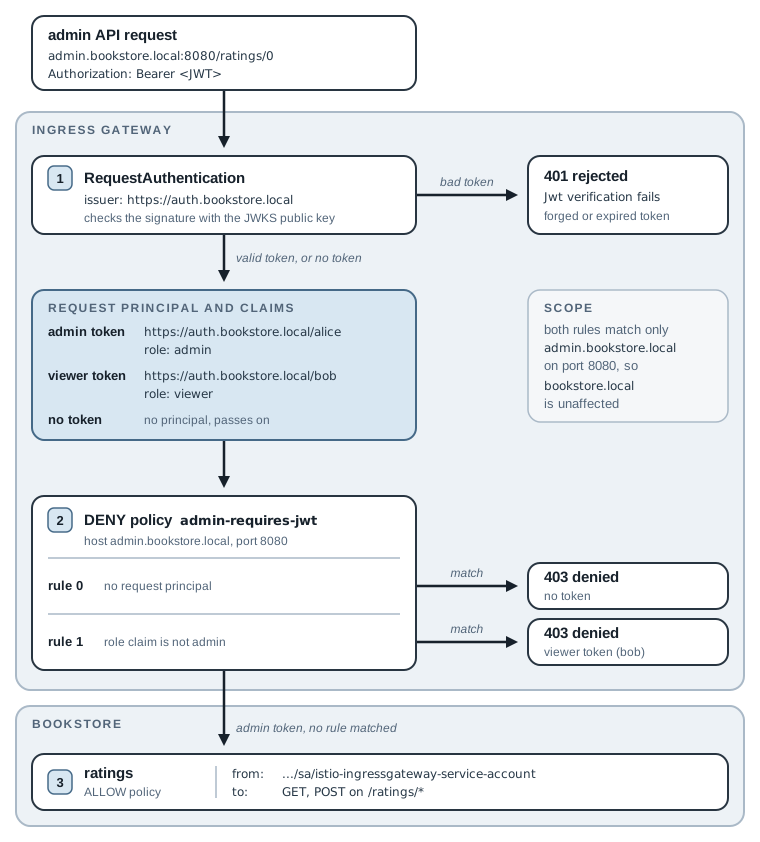
- Rule 0 denies requests with no request principal:
notRequestPrincipals: ["*"]matches when the request principal isn’t anything at all, which means no token. (A request with an invalid token never gets this far; it was already rejected with401.) - Rule 1 denies requests whose
roleclaim isn’tadmin. hostslists the name with and without a port, because curl sendsHost: admin.bookstore.local:8080when the URL has a port, as every URL on Kind does here.ports: ["8080"]limits it to the gateway’s HTTP port (the Pod port behind Service port 80). My first version left it out, andkubectl applyprinted this warning:configured AuthorizationPolicy will deny all traffic to TCP ports under its scope due to the use of only HTTP attributes in a DENY rule; it is recommended to explicitly specify the port. TCP traffic has no host, token, or claims, so when Istio builds the TCP version of aDENYrule that uses only HTTP fields, it drops those conditions. The rule then matches, and denies, every TCP connection through the gateway. Chapter 4’sPASSTHROUGHroute to payments was such traffic. It’s gone now, but a policy shouldn’t depend on that.
Why DENY and not ALLOW? The gateway serves the shop too. An ALLOW policy on the gateway
would, by rule 4, deny every request it doesn’t list, including all of bookstore.local. A DENY
policy scoped to one host leaves everything else alone.
The figure puts the two objects in order for a request to the admin host. The token check comes
first, then the DENY policy, then ratings’ own ALLOW policy from earlier:
Apply both, then send four requests to the admin host and one to the shop. The four callers are:
no token, a forged token, the viewer token, and the admin token. The forged token is written out
inline: it claims sub: mallory and role: admin from the right issuer, but its signature is
just the base64 of the word “signature”:
kubectl apply -f jwt/requestauthentication.yaml -f 12-authorization/gateway-admin-policy.yaml
R="admin.bookstore.local:8080:127.0.0.1"
curl -s -w " %{http_code}\n" --resolve "$R" http://admin.bookstore.local:8080/ratings/0
curl -s -w " %{http_code}\n" --resolve "$R" \
  -H 'Authorization: Bearer eyJhbGciOiJSUzI1NiJ9.eyJpc3MiOiJodHRwczovL2F1dGguYm9va3N0b3JlLmxvY2FsIiwic3ViIjoibWFsbG9yeSIsInJvbGUiOiJhZG1pbiJ9.c2lnbmF0dXJl' \
  http://admin.bookstore.local:8080/ratings/0
curl -s -w " %{http_code}\n" --resolve "$R" -H "Authorization: Bearer $(cat jwt/viewer.jwt)" \
  http://admin.bookstore.local:8080/ratings/0
curl -s -w " %{http_code}\n" --resolve "$R" -H "Authorization: Bearer $(cat jwt/admin.jwt)" \
  -X POST -H 'Content-Type: application/json' -d '{"Reviewer1":5,"Reviewer2":4}' \
  http://admin.bookstore.local:8080/ratings/0
curl -s -o /dev/null -w "%{http_code}\n" --resolve bookstore.local:8080:127.0.0.1 http://bookstore.local:8080/productpage
requestauthentication.security.istio.io/bookstore-jwt created
authorizationpolicy.security.istio.io/admin-requires-jwt created
RBAC: access denied 403
Jwt verification fails 401
RBAC: access denied 403
{"id":0,"ratings":{"Reviewer1":5,"Reviewer2":4}} 200
200
No token: 403. Forged token: 401, rejected before any policy runs. Viewer: 403. Admin: the
write succeeds and puts the ratings back to 5 and 4 stars, the values the anonymous request
overwrote. And the shop at bookstore.local still answers 200.
The gateway’s log names each outcome. cut -c1-200 keeps the first 200 characters of each line,
enough for the status and the reason:
kubectl -n istio-system logs deploy/istio-ingressgateway --tail=5 | cut -c1-200
[2026-11-17T02:21:13.273Z] "GET /ratings/0 HTTP/1.1" 403 - rbac_access_denied_matched_policy[ns[istio-system]-policy[admin-requires-jwt]-rule[0]] - "-" 0 19 0 - "172.21.0.4" "curl/8.7.1" "64a312a2-39a
[2026-11-17T02:21:13.292Z] "GET /ratings/0 HTTP/1.1" 401 - jwt_authn_access_denied{Jwt_verification_fails} - "-" 0 22 0 - "172.21.0.4" "curl/8.7.1" "a7581ed9-f09e-9da0-bfab-60994e1ac3e8" "admin.bookst
[2026-11-17T02:21:13.311Z] "GET /ratings/0 HTTP/1.1" 403 - rbac_access_denied_matched_policy[ns[istio-system]-policy[admin-requires-jwt]-rule[1]] - "-" 0 19 0 - "172.21.0.4" "curl/8.7.1" "301f44cb-0a2
[2026-11-17T02:21:13.323Z] "POST /ratings/0 HTTP/1.1" 200 - via_upstream - "-" 29 48 11 11 "172.21.0.4" "curl/8.7.1" "bbc0e3b4-ec87-980d-9319-6484a60c52e0" "admin.bookstore.local:8080" "10.244.1.20:90
[2026-11-17T02:21:13.344Z] "GET /productpage HTTP/1.1" 200 - via_upstream - "-" 0 15072 48 47 "172.21.0.4" "curl/8.7.1" "d8b148eb-a5dd-94c8-ba4e-8cc804785dbf" "bookstore.local:8080" "10.244.2.16:9080"
This time the brackets name the policy and the rule: rule[0] for the missing token, rule[1]
for the wrong role. The 401 comes from a different filter, jwt_authn, which checks tokens
before authorization runs.
Reset Before the Next Chapter
Chapter 13 adds a new service that calls productpage, and chapter 14 a second gateway with its
own identity. These policies would block both, so remove the policies, the token check, the admin host, and the test Pod. Keep
STRICT mTLS. --ignore-not-found is there because allow-ratings-admin.yaml and
allow-bookstore.yaml both define the ratings policy, so the second delete finds it gone.
Reapplying chapter 3’s gateway.yaml takes admin.bookstore.local off the Gateway:
kubectl delete -f 12-authorization/gateway-admin-policy.yaml -f jwt/requestauthentication.yaml
kubectl delete -f 12-authorization/allow-ratings-admin.yaml -f 12-authorization/allow-bookstore.yaml \
  -f 12-authorization/deny-all.yaml --ignore-not-found
kubectl delete virtualservice bookstore-admin -n bookstore
kubectl apply -f 03-gateway-virtualservice/gateway.yaml
kubectl -n bookstore delete pod tester
To rebuild the starting state of chapter 13 from scratch: ./scripts/bootstrap.sh 13.
Summary
AuthorizationPolicydecides who may call a workload, by mTLS principal (from), method and path (to), and conditions (when). Sidecars and gateways enforce it.- Evaluation order:
CUSTOM, thenDENY(any match denies), thenALLOW(any match allows). With anALLOWpolicy present and none matching, the request is denied; an empty policy is default deny. - Denials log
rbac_access_denied_matched_policy[...]:[none]means noALLOWmatched; a named policy and rule means aDENYmatched. A wrong principal fails silently andanalyzecan’t see it. RequestAuthenticationvalidates JWTs (401for a bad token) but lets requests without a token through. Require a token and a claim with anAuthorizationPolicy, and on a shared gateway useDENYscoped by host and port.- Next, chapter 13 shows what the sidecars have been measuring all along: metrics, traces, and the Kiali graph.