A Kubernetes Service sends traffic to every Pod whose readiness probe passes. The probe usually
calls a /health endpoint, and /health usually answers “healthy” as long as the process is up.
So a Pod that fails half of its real requests (a bad cache, say, or a broken connection to its
database) keeps receiving its full share of traffic, because its health check still passes.
Chapter 8 handled slow and failing calls one request at a time, with timeouts and retries. This
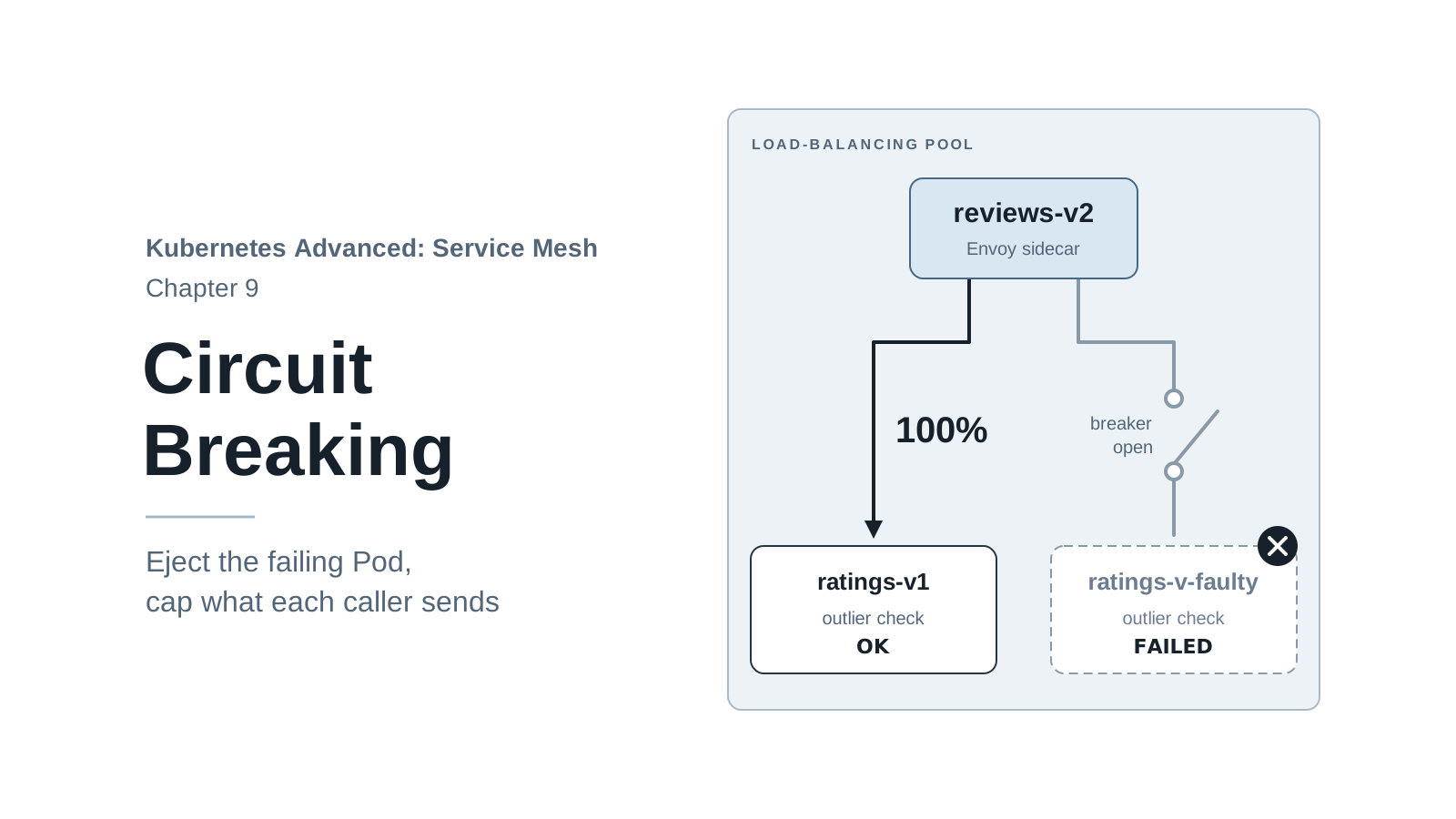
chapter works at the level of the destination. Istio’s DestinationRule can watch how each Pod
answers and remove the ones that keep failing (outlier detection), and it can cap how many
connections and waiting requests a service receives (circuit breaking), so an overloaded
service sheds load quickly instead of collapsing.
By the end of this chapter you will:
- Remove a failing Pod from the load balancer automatically with
outlierDetection, and watch it get ejected, return, and get ejected again. - See which Pods a sidecar has ejected with
istioctl proxy-config endpoint. - Cap traffic to a service with
connectionPooland recognize the503 UOit returns when the cap is reached. - Explain why outlier detection can’t save a service whose Pods are all bad.
Code for this chapter. The files are in _resource/kubernetes-service-mesh/09-circuit-breaking. I tested them with Kind v0.33.0 (Kubernetes v1.37.0) and Istio 1.32.0 on macOS with Docker Desktop, and the command output in this chapter comes from those runs.
Starting Point
Run every command from _resource/kubernetes-service-mesh:
export PATH="$PWD/bin:$PATH"
The chapter needs Book Store at http://bookstore.local:8080 and the reviews
DestinationRule from chapter 6, with no other routing objects. That’s where chapter 8’s reset
left the cluster. To build it from scratch:
./scripts/bootstrap.sh 09
A Bad Pod That Kubernetes Keeps
The ratings team ships a build with a bug: half of its answers are 503. The image has a
setting that does exactly that, SERVICE_VERSION=v-faulty. Its /health endpoint still answers
“healthy”, which is what makes this kind of bug hard to catch.
09-circuit-breaking/ratings-v-faulty.yaml deploys it next to ratings-v1, behind the same
Service. Two more files help:
fortio.yaml: Fortio, the load-testing tool from the Istio project, as a client inside the mesh. The circuit-breaking section uses it.virtualservice-reviews-v2.yaml: allreviewstraffic to v2, which callsratingson every request, so every request testsratings.
kubectl apply -f 09-circuit-breaking/ratings-v-faulty.yaml \
  -f 09-circuit-breaking/fortio.yaml \
  -f 09-circuit-breaking/virtualservice-reviews-v2.yaml
kubectl -n bookstore rollout status deploy/ratings-v-faulty
kubectl -n bookstore rollout status deploy/fortio
kubectl -n bookstore get pods -l app=ratings
deployment.apps/ratings-v-faulty created
deployment.apps/fortio created
virtualservice.networking.istio.io/reviews created
...
deployment "ratings-v-faulty" successfully rolled out
...
deployment "fortio" successfully rolled out
NAME                                READY   STATUS    RESTARTS   AGE
ratings-v-faulty-66bb9776f7-6mdvm   2/2     Running   0          20s
ratings-v1-864f4f9bd8-vwbt9         2/2     Running   0          42m
Both Pods are Running and ready. As far as Kubernetes knows, ratings is healthy. Measure what
users get:
./scripts/count-versions.sh http://bookstore.local:8080 40
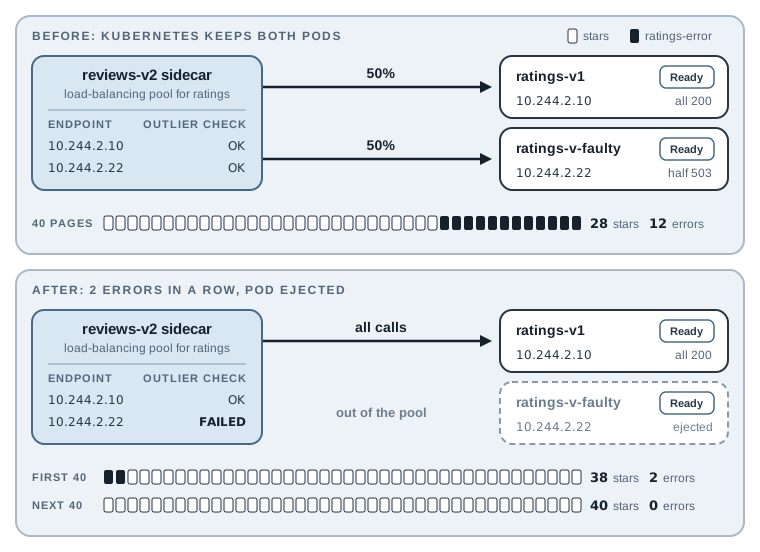
  28 200 reviews-v2 stars fast
  12 200 reviews-v2 ratings-error fast
12 of 40 pages lost their stars. The sidecar in reviews-v2 sends about half of the ratings
calls to the faulty Pod, and half of those fail, so you’d expect about a quarter of all requests
to fail; this run got a little more. No retry hides the failures: the default retry policy from
chapter 5 retries connection failures, not a 503 that the app itself returns. And Kubernetes
will keep sending traffic to this Pod for as long as it runs.
Eject the Bad Pod: Outlier Detection
Outlier detection is a passive health check. Every sidecar that calls ratings watches the
answers it gets from each ratings Pod. A Pod that crosses a threshold of failures is ejected:
removed from that sidecar’s load-balancing pool for a while. Nothing calls /health; real
traffic is the test. Each sidecar keeps its own view, so every caller has to see the failures
for itself before it stops sending to the bad Pod.
The policy for ratings is in 09-circuit-breaking/destinationrule-ratings-outlier.yaml:
apiVersion: networking.istio.io/v1
kind: DestinationRule
metadata:
  name: ratings
  namespace: bookstore
spec:
  host: ratings
  trafficPolicy:
    outlierDetection:
      consecutive5xxErrors: 2
      interval: 5s
      baseEjectionTime: 30s
      maxEjectionPercent: 50
consecutive5xxErrors: 2: two server errors in a row from one Pod trigger an ejection. The ejection happens at once, on the second error.interval: 5s: how often the sidecar sweeps its Pods. On each sweep it lets back in the ejected Pods whose time is up.baseEjectionTime: 30s: the length of the first ejection. Envoy multiplies it by the number of times the Pod has been ejected in a row, so a Pod that fails again soon after it returns stays out for 60 seconds, then 90. Every sweep that finds the Pod back in the pool takes one off that count, so a Pod that behaves for a while starts again from 30 seconds.maxEjectionPercent: 50: never eject more than half of the Pods, so a bad day for everyone doesn’t empty the pool.
Settings under trafficPolicy apply to all traffic to the host, whatever subset or route sent
it. This DestinationRule has no subsets, because nothing routes to ratings by version in this
chapter.
kubectl apply -f 09-circuit-breaking/destinationrule-ratings-outlier.yaml
./scripts/count-versions.sh http://bookstore.local:8080 40
istioctl proxy-config endpoint deploy/reviews-v2 -n bookstore \
  --cluster "outbound|9080||ratings.bookstore.svc.cluster.local"
kubectl -n bookstore get pod -l app=ratings -o wide | awk '{print $1, $6}'
destinationrule.networking.istio.io/ratings created
  38 200 reviews-v2 stars fast
   2 200 reviews-v2 ratings-error fast
ENDPOINT             STATUS      OUTLIER CHECK     CLUSTER
10.244.2.10:9080     HEALTHY     OK                outbound|9080||ratings.bookstore.svc.cluster.local
10.244.2.22:9080     HEALTHY     FAILED            outbound|9080||ratings.bookstore.svc.cluster.local
NAME IP
ratings-v-faulty-66bb9776f7-6mdvm 10.244.2.22
ratings-v1-864f4f9bd8-vwbt9 10.244.2.10
Only 2 of 40 pages lost their stars this time, down from 12. Those two were the price of
detection: the faulty Pod had to fail twice in a row before the sidecar acted. The endpoint table
shows the result. 10.244.2.22, the faulty Pod, has OUTLIER CHECK FAILED, and the sidecar
sends it nothing. Its STATUS is still HEALTHY, because that column reflects Kubernetes’ view
(the Pod is ready). The outlier check is the sidecar’s own judgment, and for load balancing it
overrides STATUS.
Watch ejection over time
An ejection isn’t permanent. The Pod comes back after its ejection time, gets real traffic again, and is ejected again if it still fails. Watch that happen: the loop below sends 10 requests about every 10 seconds for 100 seconds and prints one line per batch.
for i in $(seq 10); do
  printf '%3ss ' $(( (i-1)*10 ))
  ./scripts/count-versions.sh http://bookstore.local:8080 10 | awk '{printf "%s %s  ", $1, $4} END {print ""}'
  sleep 9
done
  0s 10 stars
 10s 10 stars
 20s 10 stars
 30s 7 stars  3 ratings-error
 40s 8 stars  2 ratings-error
 50s 10 stars
 60s 10 stars
 70s 10 stars
 80s 9 stars  1 ratings-error
 90s 9 stars  1 ratings-error
Each line is the time since the loop started and the result of that batch of 10. Read it in windows:
- 0 to 20 s: no errors. The faulty Pod is still out from the ejection during the previous command.
- 30 to 40 s: the Pod is back and fails 5 requests across two batches, until two failures land in a row and it’s ejected again.
- 50 to 70 s: out again, no errors.
- 80 to 90 s: back again, one error per batch.
Errors appear only while the Pod is back in the pool. The window edges are rough: the loop started a few seconds after the first ejection, and a Pod returns only on one of the 5-second sweeps.
Notice that the second ejection lasted about 30 seconds, not 60. I read that as the countdown from
the baseEjectionTime bullet: the Pod spent a few sweeps back in the pool before it failed twice
in a row, so its count had dropped back to zero. (That’s an inference from the timing. Envoy’s
ejection counters would confirm it, but Istio doesn’t export them by default.) A Pod that fails
again within a sweep of returning would be out for 60.
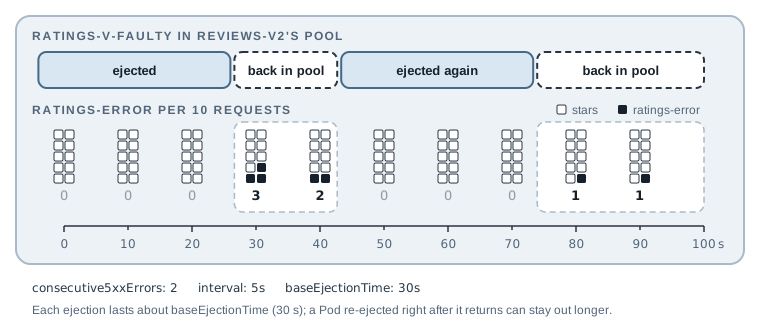
That pattern is the point: outlier detection limits the damage of a bad Pod, but it doesn’t fix the Pod. Every time the Pod returns, a few users pay for the retest. Someone still has to roll back the build. Remove it now:
kubectl delete -f 09-circuit-breaking/ratings-v-faulty.yaml
Cap the Load: Circuit Breaking
The second protection is about volume. When a service slows down, callers keep sending requests, the requests pile up in queues, memory grows, and the slow service gets slower until it falls over. A circuit breaker limits how much traffic each caller sends at once. Requests over the limit fail immediately on the caller’s side, which is faster for the caller and gives the service room to recover.
In Istio the limits are connectionPool settings in a DestinationRule.
09-circuit-breaking/destinationrule-ratings-pool.yaml keeps the outlier detection and adds:
  trafficPolicy:
    connectionPool:
      tcp:
        maxConnections: 1
      http:
        http1MaxPendingRequests: 1
        maxRequestsPerConnection: 1
maxConnections: 1: each caller’s sidecar opens at most one connection toratings(all Pods together).http1MaxPendingRequests: 1: at most one request may wait for a free connection.maxRequestsPerConnection: 1: close each connection after one request, which turns off keep-alive. Every request then needs its own turn on the one allowed connection.
These numbers are absurdly small on purpose, so a laptop can overflow them. Real limits are in the hundreds or thousands, sized from load tests.
The limits apply in each calling Pod’s sidecar, not to ratings as a whole. If three caller Pods
each allow 100 connections, ratings can receive 300. So size them from what one caller should
be allowed to send, and remember that scaling the caller out raises the total.
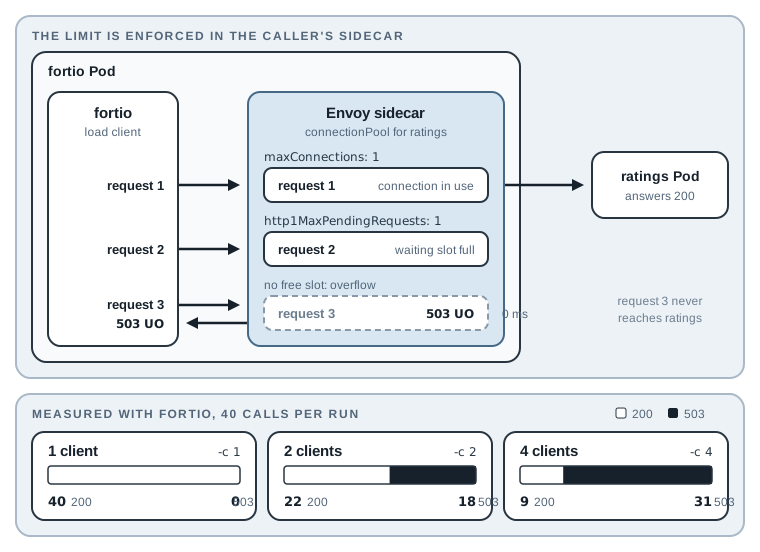
Apply it, then use Fortio to call ratings 40 times (-n 40) with 1, 2, and 4 concurrent
connections (-c). -qps 0 means “as fast as possible”, and -loglevel Warning hides
per-request logging:
kubectl apply -f 09-circuit-breaking/destinationrule-ratings-pool.yaml
for c in 1 2 4; do
  echo "== $c connections"
  kubectl -n bookstore exec deploy/fortio -c fortio -- \
    fortio load -c $c -qps 0 -n 40 -loglevel Warning http://ratings:9080/ratings/0 2>&1 \
    | grep -E "^Code|All done|Sockets used"
done
destinationrule.networking.istio.io/ratings configured
== 1 connections
Sockets used: 1 (for perfect keepalive, would be 1)
Code 200 : 40 (100.0 %)
All done 40 calls (plus 0 warmup) 1.309 ms avg, 763.7 qps
== 2 connections
Sockets used: 19 (for perfect keepalive, would be 2)
Code 200 : 22 (55.0 %)
Code 503 : 18 (45.0 %)
All done 40 calls (plus 0 warmup) 1.556 ms avg, 1200.5 qps
== 4 connections
Sockets used: 32 (for perfect keepalive, would be 4)
Code 200 : 9 (22.5 %)
Code 503 : 31 (77.5 %)
All done 40 calls (plus 0 warmup) 0.947 ms avg, 3388.7 qps
One client at a time fits the limits: 40 of 40 succeed. Four concurrent clients overflow them most of the time, as expected with room for only two requests.
Two clients are the surprise. One connection plus one waiting slot should hold two requests, yet almost half of them failed. My reading is a timing effect, not something the output proves: each connection closes after its one request, and the client that just got its answer sends the next request at once, while the other request is still waiting for a new connection. For a moment there are three requests, and the third overflows. Whatever the exact cause, the lesson for real limits is to leave headroom above the concurrency you expect.
“Sockets used” counts Fortio’s connections to its own sidecar, not the sidecar’s connections to
ratings. It rises with the 503s (19 sockets for 18 errors, 32 for 31), because Fortio opens a
new connection after an error response.
The 503s come from Fortio’s sidecar, not from ratings:
kubectl -n bookstore logs deploy/fortio -c istio-proxy --tail=40 | grep ' 503 ' | tail -1
[2026-11-17T01:50:29.629Z] "GET /ratings/0 HTTP/1.1" 503 UO upstream_reset_before_response_started{overflow} - "-" 0 81 0 - "-" "fortio.org/fortio-1.69.5" "a6552c3f-15da-4bb1-9b84-f520d68602c8" "ratings:9080" "-" outbound|9080||ratings.bookstore.svc.cluster.local - 10.96.254.132:9080 10.244.2.21:42276 - default
UO means upstream overflow: the circuit breaker tripped. The duration is 0 ms and the upstream
host is "-": the request never left the sidecar, which is the whole point. ratings never saw
it, so ratings never spent time on it.
The overflow also doesn’t count against ratings for outlier detection, because no ratings Pod
answered with an error. The endpoint table from Fortio’s side still shows the Pod as OK:
istioctl proxy-config endpoint deploy/fortio -n bookstore \
  --cluster "outbound|9080||ratings.bookstore.svc.cluster.local"
ENDPOINT             STATUS      OUTLIER CHECK     CLUSTER
10.244.2.10:9080     HEALTHY     OK                outbound|9080||ratings.bookstore.svc.cluster.local
A caller that gets 503 UO should treat it like any 503: show a fallback or fail fast. Retrying
it immediately just adds to the overload.
Break It: When Every Pod Is Bad
Outlier detection looks like it should protect users from any bad build. Test that with the
strictest policy you can write: eject after a single error, and allow every Pod to be ejected.
09-circuit-breaking/destinationrule-ratings-strict.yaml:
  trafficPolicy:
    outlierDetection:
      consecutive5xxErrors: 1
      interval: 1s
      baseEjectionTime: 60s
      maxEjectionPercent: 100
It replaces the pool DestinationRule, so the connection limits are gone and only outlier
detection is left. Now roll the faulty build out to every ratings replica, the way a bad
release really goes out: two v-faulty Pods and no v1.
kubectl apply -f 09-circuit-breaking/destinationrule-ratings-strict.yaml
kubectl apply -f 09-circuit-breaking/ratings-v-faulty.yaml
kubectl -n bookstore scale deploy/ratings-v-faulty --replicas=2
kubectl -n bookstore scale deploy/ratings-v1 --replicas=0
kubectl -n bookstore rollout status deploy/ratings-v-faulty
./scripts/count-versions.sh http://bookstore.local:8080 40
istioctl proxy-config endpoint deploy/reviews-v2 -n bookstore \
  --cluster "outbound|9080||ratings.bookstore.svc.cluster.local"
...
  20 200 reviews-v2 stars fast
  20 200 reviews-v2 ratings-error fast
ENDPOINT             STATUS      OUTLIER CHECK     CLUSTER
10.244.1.17:9080     HEALTHY     FAILED            outbound|9080||ratings.bookstore.svc.cluster.local
10.244.2.29:9080     HEALTHY     FAILED            outbound|9080||ratings.bookstore.svc.cluster.local
Half the requests failed, about what two half-broken Pods give with no outlier detection at all.
By the end of the run, both Pods are ejected. Send 20 more requests in that state and count what
reviews-v2’s sidecar did with its calls to ratings over the last 20 seconds (fields 5 to 7 of
each log line are the status, the flag, and the details):
./scripts/count-versions.sh http://bookstore.local:8080 20
kubectl -n bookstore logs deploy/reviews-v2 -c istio-proxy --since=20s \
  | grep 'ratings:9080' | awk '{print $5, $6, $7}' | sort | uniq -c
  20 200 reviews-v2 ratings-error fast
  20 200 - via_upstream
  20 503 - via_upstream
  20 503 UH no_healthy_upstream
All 20 pages lost their stars. The log covers the end of the first run too: 40 calls reached a
Pod (via_upstream), half of them failing, and then 20 calls never left the sidecar:
503 UH no_healthy_upstream, chapter 5’s flag for an empty endpoint list. With both Pods
ejected, the sidecar had nowhere to send anything.
Envoy has a safety valve for this, panic mode: when too few endpoints are healthy, it ignores
health and balances across all of them. Envoy’s default threshold is 50%. Istio sets it from
outlierDetection.minHealthPercent, which defaults to 0, and 0 turns panic mode off. You can see
it in the sidecar’s cluster config: istioctl proxy-config cluster deploy/reviews-v2 -n bookstore
--fqdn ratings.bookstore.svc.cluster.local -o json shows "healthyPanicThreshold": {}, an
empty value, which means 0.
So the strictest policy made things worse. Without outlier detection, half of the calls failed.
With consecutive5xxErrors: 1 and maxEjectionPercent: 100, every call failed, until an ejection
ran out and a Pod got another chance. The default-style maxEjectionPercent: 50 from earlier would
have kept one Pod in the pool.
The strict settings are also a risk on a healthy service. With consecutive5xxErrors: 1, one
transient 503 during a deploy or a brief database blip ejects a good Pod for a minute. With
maxEjectionPercent: 100, a blip that hits every Pod at once empties the pool, exactly as above. Keep consecutive5xxErrors above 1 and
maxEjectionPercent well below 100.
Outlier detection is for the case where some Pods are bad: one node with a broken disk, one Pod with a corrupted cache, a canary that’s worse than the stable version. For a bad release on every Pod, the tools are the ones from chapter 6: a canary that keeps most traffic on the old version, and a rollback.
Reset Before the Next Chapter
Put ratings back the way it was and remove this chapter’s objects:
kubectl -n bookstore scale deploy/ratings-v1 --replicas=1
kubectl delete -f 09-circuit-breaking/ratings-v-faulty.yaml -f 09-circuit-breaking/fortio.yaml \
  -f 09-circuit-breaking/virtualservice-reviews-v2.yaml
kubectl delete destinationrule ratings -n bookstore
kubectl -n bookstore rollout status deploy/ratings-v1
deployment.apps/ratings-v1 scaled
deployment.apps "ratings-v-faulty" deleted
deployment.apps "fortio" deleted
virtualservice.networking.istio.io "reviews" deleted
destinationrule.networking.istio.io "ratings" deleted
Waiting for deployment "ratings-v1" rollout to finish: 0 of 1 updated replicas are available...
deployment "ratings-v1" successfully rolled out
The reviews DestinationRule from chapter 6 stays. To rebuild the starting state of chapter 10
from scratch: ./scripts/bootstrap.sh 10.
Summary
- Readiness probes check whether a Pod is up, not whether it answers real requests correctly. A Pod with a bug can pass every probe and fail half of its traffic.
outlierDetectionin aDestinationRuleejects a Pod from each caller’s pool after repeated5xxerrors, then lets it back in to try again. A Pod that fails again soon after it returns stays out longer.istioctl proxy-config endpointshowsOUTLIER CHECK FAILEDfor an ejected Pod.connectionPoolcaps connections and waiting requests in each caller’s sidecar. Overflow fails immediately there with503 UO, without reaching the service.- Outlier detection only helps when some Pods are healthy. With every Pod bad and
maxEjectionPercent: 100, the pool empties and every call fails with503 UH, because Istio turns Envoy’s panic mode off. Bad releases need canaries and rollbacks. - Next, chapter 10 turns to traffic that leaves the mesh: calls to services outside the cluster.